
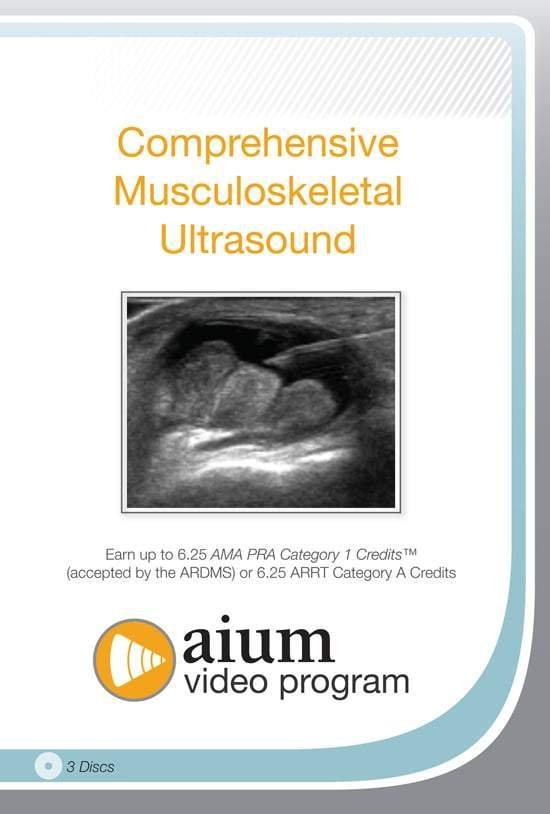
AIUM Comprehensive Musculoskeletal Ultrasound


$15.00
VIDEO COURSE · AIUM · Musculoskeletal
This comprehensive MSK ultrasound course provides structured instruction on performing musculoskeletal examinations across every major joint — shoulder, elbow, wrist, hip, knee, and foot-ankle — taught by six expert faculty with joint-specific scanning demonstrations.
-
7sessions
-
6faculty
- Joint-by-joint scanning technique for every major MSK region
- Normal anatomy and pathological findings with diagnostic criteria
- Practical demonstrations for shoulder, knee, elbow, hip, foot-ankle, and wrist
- Patient positioning and scanning protocol for comprehensive MSK evaluation
Comprehensive MSK ultrasound course for full-body joint evaluation
This comprehensive MSK ultrasound course from the AIUM delivers structured instruction on how and when to perform musculoskeletal ultrasound examinations across every major joint. Six expert faculty present seven sessions covering shoulder, knee, elbow, hip, foot-ankle, and wrist-hand — each with scanning demonstrations and the diagnostic criteria needed to build competency in MSK sonography.
Inside this resource
Upper extremity scanning: shoulder, elbow, and wrist
The shoulder module establishes the scanning approach for rotator cuff assessment, biceps tendon evaluation, and joint assessment. Elbow ultrasound covers the anterior, medial, and lateral compartments with the pronator window, distal biceps, and ulnar nerve assessment. The wrist and hand session addresses the anatomy and scanning technique for carpal and metacarpal structures.
Lower extremity scanning: hip, knee, and foot-ankle
Hip ultrasound evaluation covers anterior approach scanning with the anatomical landmarks that guide systematic joint assessment. Knee scanning is demonstrated with anterior, medial, lateral, and posterior compartment coverage. The foot and ankle session addresses both normal anatomy and the scanning technique for anterior, medial, lateral, and posterior ankle approaches.
Comprehensive scanning technique across all joints
Each session teaches the scanning protocol — patient positioning, transducer selection, and the systematic approach that ensures completeness. The programme builds toward a unified framework for MSK evaluation that clinicians can apply across the full range of musculoskeletal ultrasound examinations.
Who this serves
- Sonographers entering MSK practice — develop scanning competency across all major joints in a single structured programme
- Physicians learning MSK ultrasound — build foundational knowledge of joint evaluation with expert-led demonstrations
- Radiologists broadening MSK skills — refine scanning protocols and diagnostic criteria for comprehensive musculoskeletal assessment
Faculty & syllabus
Faculty 6 speakers
- Nathalie Bureau, MD
- J. Antonio Bouffard, MD
- Joseph Craig, MD
- Jon Jacobson, MD
- Humberto Rosas, MD
- Colin Strickland, MD
Topics covered 7 sessions
- Introduction
- Shoulder Ultrasound
- Knee Ultrasound Lecture and Demonstration
- Elbow Ultrasound Lecture and Demonstration
- Hip Ultrasound Lecture and Demonstration
- Foot/Ankle Ultrasound Lecture and Demonstration
- Wrist/Hand Ultrasound Lecture and Demonstration
Before you buy
Does this cover every major MSK joint?
Yes — the course addresses shoulder, elbow, wrist, hip, knee, and foot-ankle in a single comprehensive programme with scanning demonstrations for each region.
Is this suitable for beginners in MSK ultrasound?
The course provides foundational instruction appropriate for sonographers and physicians new to MSK scanning, with joint-specific technique demonstrations.
The chart
| Format | Video lectures (MP4) |
|---|---|
| Publisher | AIUM |
| Department | Gulfcoast Ultrasound Institute |
| Delivery | Instant download after checkout · lifetime re-access |
Verified original fileInstant downloadEncrypted checkout
6 reviews for AIUM Comprehensive Musculoskeletal Ultrasound
Add a review
Related products
Gulfcoast Ultrasound Institute
Gulfcoast Advanced MSK Ultrasound-Guided Procedures for Rehabilitation Medicine
Gulfcoast Ultrasound Institute
Gulfcoast Ultrasound Guided Prolotherapy: General Principles (Videos)
Gulfcoast Ultrasound Institute
GCUS Introduction to Peripheral Vascular Ultrasound 2022 (VIDEOS)

Gulfcoast Ultrasound Institute
Gulfcoast Ultrasound Institute
Gulfcoast Ultrasound Institute

Gulfcoast Ultrasound Institute
Gulfcoast Ultrasound Institute
drtomh –
Downloaded as a refresher before starting an MSK rotation. The comprehensive approach works well as a systematic review of scanning protocols.
Sarah K. –
Covers every major joint in one course — exactly what I needed for a broad MSK foundation. The shoulder and knee demonstrations are particularly well structured.
Priya –
Six expert faculty teaching joint-by-joint technique is excellent. The wrist and hand module adds depth that many introductory courses miss.
Marcus J. –
Good overview of scanning technique across all joints. The hip and foot-ankle sessions are especially useful for developing systematic evaluation skills.
Wei L. –
Solid introductory programme but each joint gets limited time. Would have appreciated deeper coverage of diagnostic criteria for the shoulder specifically.
Lynn C. –
Practical demonstrations across all regions make this a useful reference library. The patient positioning guidance is something I now use daily.