
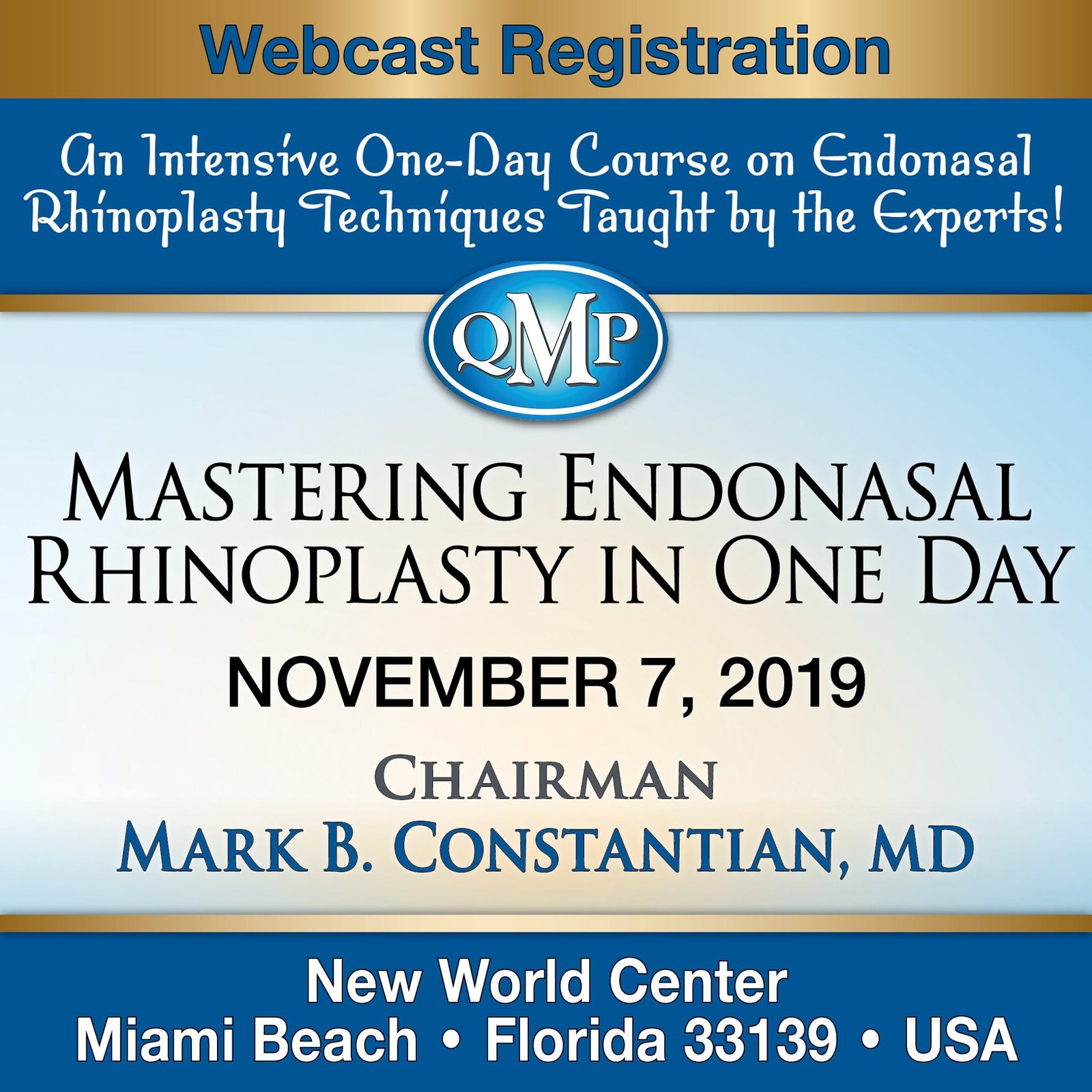
Live Webcast for Mastering Endonasal Rhinoplasty QMP

$35.00
Video Course · ENT · 2020
Dr. Enrico Robotti leads a comprehensive master class on endonasal rhinoplasty webcast — delivering over 9 hours of HD instruction on closed approach technique refinement, complication avoidance, and aesthetic optimization through a live interactive format.
-
9+hours
-
1faculty
-
2020year
- Endonasal approach selection and cartilage manipulation
- Suture techniques and graft positioning through closed access
- Tip projection management via the endonasal route
- Complication prevention and aesthetic balance strategies
Mastering endonasal rhinoplasty — Dr. Robotti’s closed approach masterclass
Over nine hours of HD streaming content center on endonasal rhinoplasty webcast techniques delivered through an interactive webcast with real-time faculty engagement. Dr. Enrico Robotti shares technique refinements developed through years of operative practice, concentrating on maneuvers that produce aesthetic harmony while maintaining nasal performance. The curriculum covers every stage of the closed technique — from preliminary evaluation and tip manipulation to dorsal reshaping and framework reinforcement — emphasizing repeatable approaches that reduce complication likelihood.
-
9+hours
-
1faculty
-
2020year
Inside this resource
Endonasal approach selection and technique refinement
Dr. Robotti systematically addresses approach selection criteria — when the closed approach is appropriate, which nasal anatomies favor endonasal access, and how to modify technique when intraoperative findings differ from the preoperative plan. The program covers cartilage manipulation, suture techniques, and graft positioning through the limited exposure of the endonasal route, demonstrating how experienced surgeons achieve results comparable to open approach through precise instrument handling and refined tactile feedback.
Tip projection and dorsal modification through closed access
Dedicated segments address the two most technically demanding aspects of endonasal rhinoplasty: tip projection management and dorsal hump reduction through the closed approach. Dr. Robotti demonstrates how controlled tip work through intercartilaginous or transfixion incisions achieves projection goals without the exposure advantages of the open approach. The dorsal modification segments show how to achieve smooth, predictable contours using limited visualization combined with palpation-guided technique.
Complication prevention and aesthetic principles
A core theme throughout the webcast is complication avoidance through technique selection. Dr. Robotti discusses how to minimize common pitfalls — asymmetric tip work, over-resection of the dorsum, and graft displacement — by applying structured decision-making at each intraoperative juncture. The aesthetic philosophy emphasizes natural results that respect individual nasal anatomy rather than imposing a single template across all patients.
Who this serves
- Rhinoplasty surgeons — advanced closed approach technique refinement from a master surgeon
- Facial plastic surgery fellows — understanding when and how to apply endonasal techniques
- Plastic surgery residents — foundational knowledge of closed approach rhinoplasty principles
The chart
| Format | HD Streaming |
|---|---|
| Duration | 9+ hours |
| Publisher | Quality Medical Publishing |
| Department | ENT |
| Delivery | Instant download after checkout · lifetime re-access |
Verified original fileInstant downloadEncrypted checkout
6 reviews for Live Webcast for Mastering Endonasal Rhinoplasty QMP
Add a review
Related products






Claire J. –
Dr. Robotti’s emphasis on reproducible methods that minimize complication risk resonated with my practice philosophy. The aesthetic principles section is particularly well articulated.
Lisa M. –
I attended the live webcast and later rewatched specific segments on demand. Both experiences were valuable — live interaction added a dimension that recorded content alone cannot provide.
Yusuf K. –
The section on tip projection management through the endonasal route was the clearest instruction I’ve encountered on this topic. Robotti’s emphasis on tactile feedback is a key takeaway.
Hannah S. –
As someone primarily trained in open rhinoplasty, this webcast gave me the confidence to start incorporating closed approaches for appropriate patients. The technique pearls are immediately applicable.
Marco V. –
Robotti’s real-time commentary during procedure walkthroughs gave me insights into instrument handling that I couldn’t get from textbooks or open approach courses.
Robert P. –
Good course for mid-career rhinoplasty surgeons looking to add closed techniques. The asymmetry correction module addressed scenarios I encounter regularly in practice.