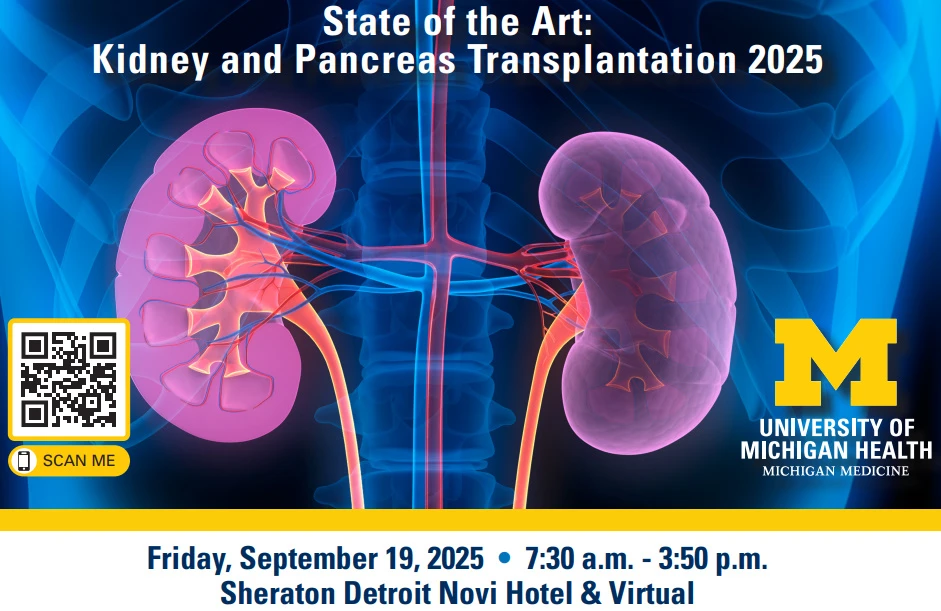
Michigan Medicine State of the Art Kidney and Pancreas Transplantation 2025
$10.00
Video Course · Nephrology · 2025
Michigan Medicine’s 2025 course confronts the growing challenge of transplanting older candidates across 11 lectures — addressing frailty scoring, deceased donor offer decisions, Medicare Advantage billing surprises, and living donation after age 50.
-
11lectures
-
14speakers
-
2025year
- Frailty and sarcopenia in transplant outcomes
- Medicare Advantage hidden costs for programs
- Living donor evaluation beyond age 50
Kidney and pancreas transplantation — confronting frailty, finances, and the donor landscape
Frailty is reshaping how transplant programs evaluate elderly recipients and aging donors, and Michigan Medicine’s 2025 course confronts this challenge head-on. Eleven lectures recorded on September 19, 2025 at the Sheraton Detroit Novi address the multidisciplinary realities of transplanting older candidates — from sarcopenia scoring and medication optimization to Medicare Advantage billing surprises and the strategic calculus of accepting deceased donor offers. Kidney pancreas transplantation practice in the era of aging populations requires exactly this kind of practical, center-specific perspective.
-
11lectures
-
14speakers
-
2025year
Inside this resource
Frailty assessment and the aging transplant candidate
Two sessions address how frailty, deconditioning, and sarcopenia affect CKD progression and transplant outcomes. Faculty explore practical assessment tools and management strategies for elderly recipients, including a dedicated lecture on medication considerations unique to patients over 65.
Deceased donor offer navigation
A 50-minute session dissecting the current landscape of deceased donor kidney offers — when to accept, when to decline, and how to counsel patients through the decision. Michigan Medicine’s approach to maximizing organ access while minimizing non-utilization of viable organs is presented with institutional data.
Medicare Advantage and transplant program finances
Medicare Advantage plans introduce hidden costs that catch programs and patients off guard. A dedicated session breaks down billing differences, coverage gaps, and advocacy strategies that every transplant team needs to understand before listing candidates with these plans.
Living donation beyond age 50
Two lectures evaluate living donor candidates over 50, examining acceptance criteria, long-term outcomes data, and the patient and caregiver perspective on living donation after age 70. A session on the direct-to-pre-op pathway outlines what donors should expect from evaluation through surgery.
Who this serves
- Transplant nephrologists — optimizing waitlist management and evaluating older candidates
- Transplant surgeons — navigating donor offer decisions and expanding living donation criteria
- Transplant coordinators and social workers — addressing financial and psychosocial complexities in elderly recipients
Before you buy
Does this course cover pancreas transplantation specifically?
Kidney transplantation dominates the curriculum. Pancreas transplant content is limited — the course is primarily focused on kidney transplant challenges in aging populations.
Are presentation slides included?
No — the purchase includes 11 video lecture recordings without accompanying PDF slides.
The chart
| Format | Video Course (11 lectures) |
|---|---|
| Year | 2025 |
| Publisher | Michigan Medicine |
| Department | Nephrology |
| Delivery | Instant download after checkout · lifetime re-access |
Verified original fileInstant downloadEncrypted checkout
6 reviews for Michigan Medicine State of the Art Kidney and Pancreas Transplantation 2025
Add a review
Related products
Nephrology
Nephrology
Nephrology
Nephrology
Robert M. –
clean structure with actionable clinical pearls throughout. The direct-to-pre-op pathway lecture was a nice practical touch for donor education.
Jennifer L. –
Michigan Medicine brings real-world transplant center experience that academic lectures often lack. The donor offer session was outstanding.
Ahmed K. –
Wished for more on pancreas transplantation specifically — kidney dominates the curriculum. The kidney content itself is excellent though.
Maria G. –
The patient perspective on living donation after 70 was moving and informative. Changed how I counsel older donor candidates in my practice.
Steven P. –
Frailty assessment tools were practical and immediately usable. The only downside is no PDFs to reference later during case reviews.
Karen D. –
The Medicare Advantage session saved our program from a billing disaster we had not anticipated. Every transplant coordinator needs to hear this.