
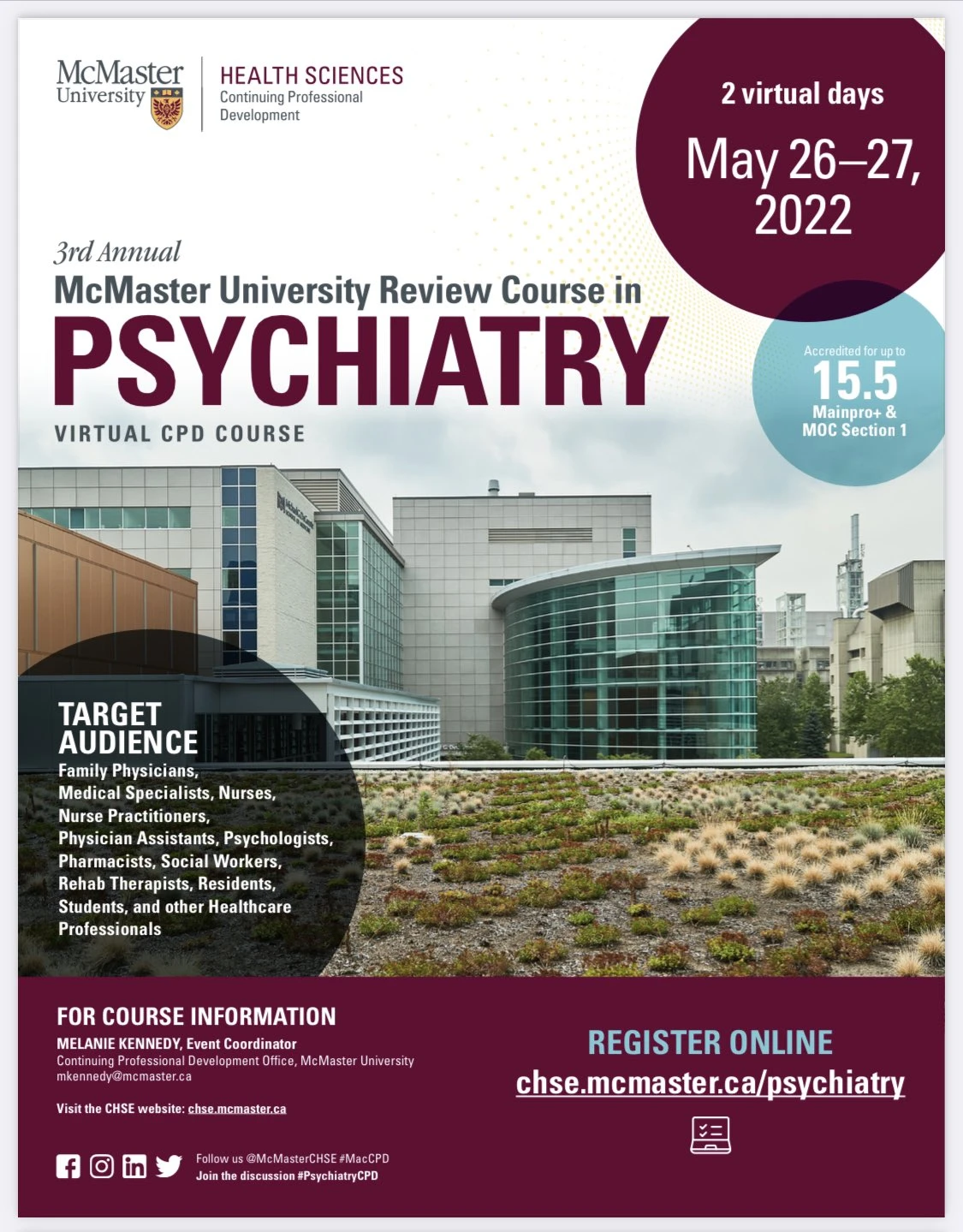
McMaster University 3rd Annual McMaster University Review Course in Psychiatry 2022


$15.00
Video Course · Psychiatry · 2022
The McMaster psychiatry review 2022 delivers 28 video sessions plus a PDF study guide from the 3rd Annual McMaster University Review Course, covering ADHD, bipolar, personality disorders, trauma-informed care, substance use, and diverse populations — 3.4 GB of practical psychiatric education.
-
28video sessions
-
3.4GB total
-
2022edition
- Third annual review course from McMaster University
- Covers ADHD, bipolar, eating disorders, dementia, and psychosis
- Addresses 2SLGBTQ+, Indigenous, and racialized community mental health
- Includes motivational interviewing, apps, and cannabis prescribing
28 Practical Sessions From the 3rd Annual McMaster University Psychiatry Review
The McMaster psychiatry review 2022 presents 28 video sessions and a PDF study guide from McMaster University’s third annual review course. Designed for family physicians, medical specialists, nurses, and allied health professionals, this 3.4 GB collection covers ADHD across the lifespan, bipolar disorder, personality disorders, substance use, eating disorders, and mental health considerations for Indigenous, racialized, and 2SLGBTQ+ populations.
-
28video sessions
-
3.4GB total
-
2022edition
Inside this resource
Core Psychiatric Conditions and Lifespan Perspectives
The McMaster psychiatry review features sessions on ADHD management in adults, bipolar disorder from a lifespan perspective, diagnosing and managing dementia, and personality disorders including narcissistic and borderline presentations. Depression with comorbid substance use and treatment-resistant depression are addressed alongside panic attacks and their differential diagnosis.
Substance Use, Addictions, and Prescribing
The McMaster psychiatry review includes sessions on substance use disorder assessment and treatment, behavioral addictions, and cannabis prescribing guidance. Motivational interviewing techniques and anti-depressant and anti-psychotic medication monitoring round out the pharmacotherapy and psychotherapy education.
Diverse Populations and Special Topics
Dedicated sessions address 2SLGBTQ+ mental health, Indigenous peoples, racialized communities, and intellectual disabilities from a mental health perspective. Women’s mental health spans from pre-menstrual dysphoric disorder through menopause, while eating disorders and suicidality safety planning address acute clinical presentations.
Contemporary Issues and Practical Tools
Sessions on long COVID neurocognitive effects, healthcare worker occupational hazards, mental health apps and online resources, and trauma-informed care during the pandemic reflect current clinical challenges. Insomnia and panic attack management provide immediate take-away skills for frontline practice.
Who this serves
- Family physicians and primary care providers — managing common psychiatric presentations without specialized referral access
- Nurses, nurse practitioners, and physician assistants — expanding psychiatric knowledge for multidisciplinary care delivery
- Residents, students, and allied health professionals — building practical psychiatric competencies across diverse populations
Faculty & syllabus
Sessions included 28 lectures
- 2SLGBTQ+ Mental Health — what every clinician should know
- 10 Mental Health Hacks for Health Care Professionals — practical self-care strategies
- ADHD in Adults — diagnosis and management approaches
- Anti-Depressants and Anti-Psychotic Medications — monitoring for side effects
- Substance Use Disorder — assessment and treatment approach
- Behavioural Addictions — gambling, gaming, and process addictions
- Bipolar Disorder — lifespan perspective on management
- Dementia — diagnosing and managing cognitive decline
- Narcissistic and Borderline Personality Disorders — diagnosis and management
- Eating Disorders — clinical assessment and intervention
- Women’s Mental Health — pre-menstrual dysphoric disorder through menopause
- Insomnia — non-pharmacological and pharmacological management
- Suicidality — developing safety plans and risk assessment
- Mental Health Apps and Online Resources — digital tools for patients
- Indigenous Peoples — mental health considerations and culturally safe care
- Racialized Communities — mental health of racialized people
- Motivational Interviewing — communication techniques for change
- Long COVID — neurocognitive effects and clinical management
- Healthcare Worker Hazards — occupational mental health risks
- Panic Attacks — cause, differential diagnosis, non-pharmacological treatment
- Intellectual Disabilities — a mental health perspective
- Trauma Informed Care — principles and pandemic application
- Child and Adolescent Psychopharmacology — prescribing considerations
- Depression with Substance Use — integrated treatment approaches
- Treatment Resistant Depression — augmentation and alternatives
- Psychosis — early identification and acute management
- Anxiety — evidence-based treatment across presentations
- Cannabis Prescribing — clinical considerations and guidelines
Before you buy
What is the total file size?
The McMaster psychiatry review 2022 includes 28 video files and 1 PDF totaling 3.4 GB, making it one of the more storage-friendly comprehensive review courses available.
Is this appropriate for non-psychiatrist clinicians?
Absolutely. The course is designed for family physicians, nurses, nurse practitioners, physician assistants, pharmacists, social workers, and other healthcare professionals who encounter psychiatric presentations in their practice.
Does it cover diverse and underserved populations?
Yes. Dedicated sessions address mental health for 2SLGBTQ+ individuals, Indigenous peoples, racialized communities, and patients with intellectual disabilities, reflecting contemporary inclusive practice standards.
The chart
| Format | 28 MP4 + 1 PDF |
|---|---|
| File Size | 3.4 GB |
| Year | 2022 |
| Publisher | McMaster University |
| Department | Psychiatry |
| Delivery | Instant download after checkout · lifetime re-access |
Verified original fileInstant downloadEncrypted checkout
6 reviews for McMaster University 3rd Annual McMaster University Review Course in Psychiatry 2022
Add a review
Related products



Psychiatry



Psychiatry
drtomh –
The 2SLGBTQ+ mental health session and the Indigenous peoples lecture brought perspectives I rarely see in standard CME. Each of the 28-session lectures is focused and actionable.
Chen W. –
Good variety across the 28 sessions from eating disorders to long COVID neurocognitive effects. The sessions on racialized communities and healthcare worker hazards added welcome diversity.
Priya N. –
The ADHD in adults and bipolar lifespan sessions were thorough and current. At just 3.4 GB, this is one of the most storage-friendly comprehensive review courses available.
Sarah K. –
McMaster delivers again with practical content I can apply immediately. The motivational interviewing and trauma-informed care sessions were excellent additions to my clinical toolkit.
James L. –
Strong mix of clinical and population-level topics. The mental health apps session was forward-looking. Some lectures felt compressed given the breadth of material covered.
Ahmed F. –
Solid review course but the 28-session format means each topic gets limited depth. The cannabis prescribing and treatment-resistant depression lectures were the most clinically detailed.