
DentistryOnline courseOrthodontics
Kazumi Ikeda’s TMJ-First orthodontics — stabilise the mandible, then move the teeth
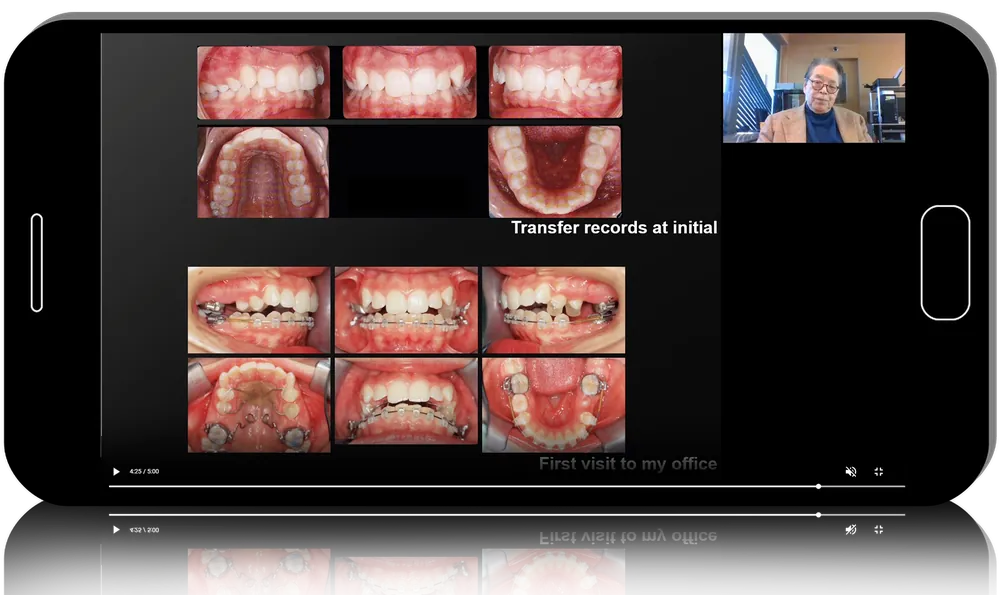
Orthodontist Kazumi Ikeda, who has headed the Roth Williams Center in Japan since 1990, condenses more than three decades of clinical work into TMJ First Orthodontics. Author’s course by Kazumi Ikeda. Six lessons totalling 8 h 35 min explain how to diagnose mandibular position, deal with disc displacement and 3D discrepancies before treatment, and use Roth mechanics to keep the mandible stable once braces come off.
- 6lessons
- 8 h 35 minof video
- 30+years of the author’s practice
What you’ll be able to do
- Tell a stable from an unstable mandibular position at the first consultation
- Use CBCT and MRI to read TMJ condition and recognise normal joint images
- Stage disc displacement in growing patients and time splint therapy against orthodontics
- Prioritise correction of vertical and lateral mandibular discrepancies in the plan
- Apply Roth straight-wire mechanics, torque and molar vertical control for lasting stability
Inside the course
Finding the true mandibular position
Ikeda starts with why the jaw position recorded at a first visit is often unreliable, how muscle relaxation reveals the real one, and how to analyse cases referred from other practitioners.
Disc displacement in young patients
A full lesson looks at how common disc displacement is among growing orthodontic patients, how it can progress, how to judge its stage and when a splint should come before brackets.
Discrepancies and mechanics
Three-dimensional mandibular discrepancies are built into planning with a worked case, followed by Roth’s modifications of the Andrews straight-wire approach, en-masse anterior retraction and vertical molar control.
Face, growth and function
The last lesson ties mandibular growth and joint health to facial aesthetics and closes with protocols for functional occlusion and analysis of joint movement.
Built for
- OrthodontistsA joint-centred planning sequence that tackles relapse and TMJ complaints.
- Roth-philosophy practitionersMechanics explained by a long-standing Roth Williams director.
- Clinicians treating adolescentsGrowth-period TMJ problems get specific attention.
Curriculum
Diagnosing Mandibular Position: Key Considerations and Techniques (1 h 14 min) 5 topics
- Challenges in assessing mandibular position during the initial visit
- Understanding 3D mandibular discrepancies
- Stable vs. unstable mandibular positions
- Diagnostic tools in clinical practice: CBCT and MRI
- Special considerations for referred cases and their treatment analysis
Stabilizing Mandibular Position Before Orthodontic Treatment (1 h 37 min) 5 topics
- Identifying a stable mandibular position for effective treatment planning
- Understanding TMJ conditions and recognizing normal TMJ images
- Addressing TMJ instability before initiating orthodontic treatment
- The role of muscle relaxation in obtaining an accurate mandibular position
- Strategies for resolving 3D mandibular discrepancies before treatment
Assessing and Managing Disc Displacement (1 h 15 min) 7 topics
- The importance of the TMJ in mandibular stabilization
- Disc displacement (D.D.) as the most common TMJ issue
- Prevalence of D.D. in growing patients seeking orthodontic treatment
- Potential for progressive changes in the TMJ due to D.D
- Analysis of the stages of D.D. and assessment of the patient’s current condition
- Protocols for the management of D.D
- Evaluating the optimal timing for splint therapy and orthodontic intervention
Integrating 3D Mandibular Discrepancies into Orthodontic Treatment Planning (1 h 13 min) 5 topics
- Mandibular discrepancies in treatment planning
- The significance of vertical discrepancies
- Protocols for identifying and addressing lateral discrepancies
- Prioritizing the correction of 3D mandibular discrepancies
- Developing a treatment plan based on an actual case study
Biomechanics for Mandibular Position Stability (1 h 30 min) 7 topics
- The role of mandibular position in orthodontic treatment planning
- Key features of Roth treatment mechanics
- The significance of torque in the straight wire treatment approach
- Roth’s modifications to Andrews’ straight wire technique and its impact on occlusion
- Biomechanics: the efficiency of en-masse movement for anterior teeth alignment
- The importance of vertical control in the molar region for mandibular stability
- Analysis of clinical cases: applying TMJ-First mechanics in treatment planning
Aesthetic and Functional Orthodontic Treatment Approach (1 h 44 min) 7 topics
- Role of the growth of the mandible in facial aesthetics
- Importance of functional TMJ in achieving facial harmony
- Impact of growth-period problems on the TMJ
- Consequences of TMJ issues on facial appearance
- Long-term benefits of balanced orthodontic outcomes for aesthetics and function
- Protocols for achieving functional occlusion
- Analysis of TMJ movement and occlusion stability
Before you buy
Does the TMJ-First method require MRI for every patient?
The course presents CBCT and MRI as diagnostic tools and explains how they inform assessment; how routinely you image remains a clinical decision.
Has Ikeda written books on this approach?
Yes: TMJ 1st Orthodontics appeared in 2014, followed in 2021 by Face Design and Orthodontics.
Do I get CME credit or a certificate?
No. Clinicapedia provides the educational content only — no CME or CE credits, MOC points or certificates of completion are included with this product.
Specifications
| Format | Online video course |
|---|---|
| Instructor | Kazumi Ikeda |
| Contents | 6 lessons |
| Duration | 8 h 35 min |
| Access | Lifetime, self-paced |
| Department | Dentistry |
| Delivery | Instant download · lifetime re-download |
Related products