

DentistryOnline courseEndodontics
Domenico Ricucci’s histology-driven endodontics — caries excavation, pulp capping, apical limits, lateral canals and regeneration
Few clinicians can show what actually happens inside the pulp the way Domenico Ricucci can: he has run his own histology laboratory since 1998. In Biologically Based Endodontics he spends 9 h 45 min across five long lectures linking tissue sections to chairside decisions, from how deep to excavate caries to whether revascularization truly regenerates anything.
- 5lectures
- 9 h 45 minof video
- 112papers by the author
What you’ll be able to do
- Judge reversible versus irreversible pulpitis and know how far clinical signs match histology
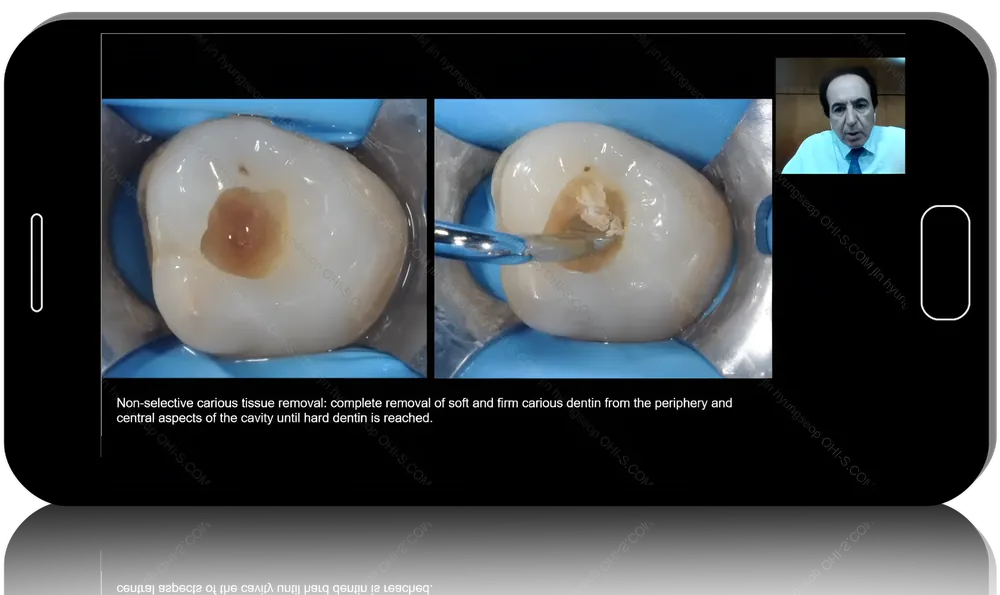
- Decide between selective and complete caries excavation in deep lesions
- Carry out direct and indirect pulp capping and partial pulpotomy with suitable biomaterials
- Set a defensible apical limit for shaping and filling, using patency and apex locators
- Weigh what lateral canals mean for healing and when surgery is warranted
- Approach immature roots with realistic expectations of regenerative procedures
Inside the course
From carious lesion to inflamed pulp
The first two lectures trace how the pulp reacts beneath shallow and deep caries, examine tertiary dentin and odontoblast changes, and question whether bacteria sealed under a restoration are really inactivated. Vital pulp therapy follows, with a decision algorithm, bioceramic options and a partial pulpotomy demonstration.
Where instrumentation should stop
Lecture three covers apical constriction, working length and patency, debris packing, biofilm location and calcium silicate sealers, illustrated with apex locator cases and histological healing.
Ramifications and regeneration
The fourth lecture asks whether radiographically filled lateral canals are genuinely sealed and whether ultrasonic cleaning helps. The last one looks at dentin types, MTA, revascularization and protocols for teeth with open apices.
About Domenico Ricucci
A Rome-trained physician and dentist, he directs his own training centre and researches pulpal and periapical responses, endodontic biofilms and causes of treatment failure.
Built for
- EndodontistsTissue-level evidence to support or challenge everyday protocols.
- General dentists doing root canalsClear reasoning on deep caries, capping and perforations.
Curriculum
Lesson 1: Tissue response to caries and the depth of excavation (2 h 03 min) 12 topics
- Etiology of pulp diseases: superficial caries, caries in the spot stage, dental caries, deep caries
- Histological events in the pulp tissue below medium-deep caries lesions
- Morphology of tertiary dentin and regressive changes in the odontoblast layer
- Can new odontoblasts form from undifferentiated pulpal stem cells: fact or fantasy?
- Histological and microbiological events in the transition from reversible to irreversible pulp inflammation
- Clinical diagnosis of reversible or irreversible pulpitis and its correlation with histology
- The selective excavation concept: critical analysis of recent literature
- Caries excavation: complete or incomplete
- Clinical protocols for complete (non-selective) caries excavation
- Treatment of deep cavities: contradictions and misconceptions
- Dense pigmented dentin: remove or leave
- Do bacteria sealed in a cavity by a hermetic restoration become harmless?
Lesson 2: Deep caries lesions, exposed pulp and vital pulp therapy (2 h 02 min) 10 topics
- Reversible and irreversible pulpitis: clinical signs
- The concept of indirect pulp capping
- Direct pulp capping: indications, contraindications, early and late failures, methodology
- Cracks in the dentin: tactics
- Partial pulpotomy: technique demonstration
- Bioceramic materials: options and properties
- Choice of treatment method: decision-making algorithm
- Sensitivity after direct pulp capping: tactics
- Materials for direct pulp capping
- Calcium hydroxide, the first biomaterial in the history of dentistry
Lesson 3: Apical limit of root canal instrumentation and obturation (2 h 10 min) 13 topics
- Apical limit of instrumentation and obturation: nomenclature
- Apical constriction: definition
- Histological and histobacteriological conditions of the root canal
- Apical patency and the concept of working length
- Prevention of debris accumulation
- Manipulations around the radiographic apex: consequences
- Microbial biofilm: localization
- Biological healing: histological aspects
- Pulp degeneration: progression of the process
- Mineralized deposits of endodontic origin
- Working with the apex locator: clinical examples
- The role of calcium silicate-based sealers
- Root canal treatment and irrigation: clinical recommendations
Lesson 4: Lateral canals in endodontics — the never-ending story (1 h 37 min) 10 topics
- Obturation of lateral canals: influence on treatment outcome
- Histopathological status of tissues in lateral canals
- Infection in lateral canals: effect on healing
- Elimination of apical infection: method
- Complexity of treating lateral canals: histological justification
- Effectiveness of ultrasonic cleaning of lateral canals
- Reasons for failure in cleaning and obturating lateral canals
- Does radiographic filling of ramifications match their actual obturation?
- Lateral lesions: indications for surgery
- Vital tissue in lateral canals: should it be removed?
Lesson 5: Regenerative endodontic procedures — are we really regenerating? (1 h 54 min) 10 topics
- Morphology of tooth tissue repair: reactive and reparative dentin; primary, secondary and tertiary dentin; the role of odontoblasts
- Clinical criteria for pulp regeneration
- Modern endodontic materials: MTA, calcium silicate
- Revascularization: definition and clinical significance
- Variants of tissue response to treatment
- Embryology of dentin-pulp complex regeneration
- Infection control as a stage of regeneration
- Pulp necrosis and apical periodontitis: factors in successful regeneration
- Ideal regeneration for bone and the dentin-pulp complex
- Protocols for teeth with immature roots
Before you buy
Is this a hands-on shaping and obturation course?
Mostly not. It is lecture-based and centred on histology and biological reasoning, with clinical demonstrations such as a partial pulpotomy woven in.
Does it address perforations and complicated situations?
Yes, the course includes tactics for an accidental perforation and for managing difficult clinical scenarios.
Do I get CME credit or a certificate?
No. Clinicapedia provides the educational content only — no CME or CE credits, MOC points or certificates of completion are included with this product.
Specifications
| Format | Online video course |
|---|---|
| Instructor | Domenico Ricucci |
| Contents | 5 lectures · 55 listed topics |
| Duration | 9 h 45 min |
| Access | Lifetime, self-paced |
| Department | Dentistry |
| Delivery | Instant download · lifetime re-download |
Related products





Addiction Medicine