

DentistryOnline courseSurgery
Tissue-level implants, split crest, conometric restorations, dynamic navigation and porcine grafts in one Italian-Spanish update
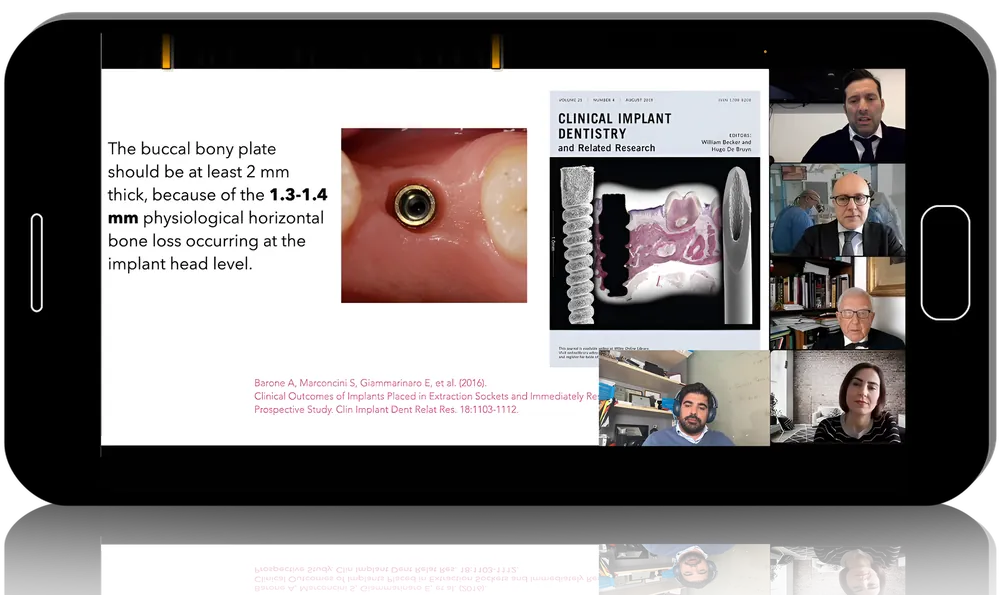
Five speakers from Italy and Spain — Simone Marconcini, Daniel Robles Cantero, Adriano Piattelli, Luca Comuzzi and Natalia Di Pietro — present Contemporary Advances in Implantology: New Materials and Updated Protocols in six lessons lasting 5 h 33 min. Topics range from hybrid and tissue-level fixtures in the esthetic zone and narrow-ridge augmentation to Cone Morse connections, navigated placement and long-term sinus lift results with porcine bone.
- 6lessons
- 5 h 33 minof video
- 5lecturers
- 20+ yearssinus lift follow-up
What you’ll be able to do
- Choose between bone-level, tissue-level and hybrid implants in the anterior maxilla
- Manage post-extraction socket remodelling with minimally invasive 3D placement
- Carry out a split crest and know the predictable alternatives for thin ridges
- Use Cone Morse connections and biconometric caps for provisional and final restorations
- Achieve parallel implants with dynamic navigation in partial and full-arch cases
- Graft the sinus with porcine-derived biomaterials and read ISQ and insertion torque
Inside the course
Tissue-level fixtures for esthetics
Two lessons trace the history of transmucosal implants, explain the biological rationale for hybrid designs and show how to place them in different socket types after extraction.
Horizontal augmentation
A pair of lectures addresses the morbidity of complex regeneration in atrophic maxillae, then details split crest steps, its advantages, and options when bone volume is compromised.
Conometry and navigation
The longest session, just over two hours, covers spacing and vertical position, immediate loading, the Navident system with AI-assisted planning and how bone responds to different prosthetic connections.
Extreme rehabilitation
The closing lesson looks at implant macro-designs for low bone height, zygomatic implants, underpreparation and apex contact with the sinus membrane, and porcine graft biology with cases followed for more than two decades.
Built for
- Implantologists and oral surgeonsA compact refresher on newer materials and connection concepts.
- General dentists placing implantsClear criteria for socket management and ridge width problems.
Curriculum
Lesson 1: Tissue Level Implants in Aesthetic Implant Dentistry: Strategies and Innovations (31 min) 11 topics
- Tissue level implants and their historical background
- Bone level vs. tissue level implants
- Hybrid implants
- Advantages in treating the aesthetic zone
- Biological rationale behind the use of hybrid implants
- Post-extractive alveolar bone resorption and its management
- Protocols for 3D placement of tissue level implants in the aesthetic zone
- Protocols for mini-invasive approaches in implant dentistry
- Post-extractive alveolar socket remodeling
- Analysis of clinical cases
- Management of different post-extractive alveolar sockets in various clinical cases
Lesson 2: Tissue Level Implants in Clinical Everyday Practice (39 min) 5 topics
- Protocols for 3D placement of tissue level implants in the aesthetic zone
- Protocols for mini-invasive approaches in implant dentistry
- Post-extractive alveolar socket remodeling
- Analysis of clinical cases
- Management of different post-extractive alveolar sockets in various clinical cases
Lesson 3: Horizontal Bone Grafting: New Approaches to Avoid Complications (33 min) 6 topics
- Maxillary bone atrophy: Complex regeneration surgeries with high morbidity
- Protocols for the horizontal augmentation technique
- Step-by-step protocols for the split crest technique
- Predictable alternatives to the split crest technique
- Management of severe horizontal atrophy cases and management of long-term and short-term complications
- Analysis of clinical cases
Lesson 4: Horizontal Bone Grafting with Split Crest Technique (21 min) 5 topics
- Step-by-step protocols for the split crest technique
- Predictable alternatives to the split crest technique
- Clinical advantages of the split crest technique
- Rehabilitation options for cases with compromised bone volume
- Analysis of clinical cases
Lesson 5: Cone Morse Connections, Biconometric Prosthetic Concept, and Dynamic Navigation in Implantology (2 h 07 min) 13 topics
- Clinical advantages of Cone Morse implants and benefits of employing Biconometry in dental implant procedures
- Simplification of implant procedures with Cone Morse implants and Biconometry
- Analysis of common clinical challenges
- Implant spacing and vertical implant placement
- Provisional restorations and immediate loading
- Clinical application of navigation technology to enhance precision and ensure parallelism between implant placements
- Management of edentulous cases using Biconometry and Navigation with immediate loading protocols
- Clinical application of Navident system
- Integrated data analysis and AI assistance for simplified implant planning with Navident
- The use of caps for provisional and definitive Biconometry restorations
- Analysis of clinical cases
- Application of navigation technology in partial and full edentulous cases
- Bone response to various prosthetic connections
Lesson 6: Maxillary Sinus Augmentation: Extreme Rehabilitation with Porcine-Derived Biomaterials (1 h 20 min) 14 topics
- Introduction to new implant macro morphologies designed to enhance primary stability, particularly in cases with limited vertical bone volume
- Innovations in implant dentistry: Zygomatic implants and complex surgical interventions
- Management of edentulous cases
- Protocols of the biconometry approach
- Navigation techniques
- Immediate loading protocols
- The role of porcine biomaterials in advanced surgical techniques for extreme rehabilitation
- Analysis of the osteoconductive and osteoinductive properties of porcine-derived biomaterials
- Porcine-derived materials in promoting new bone formation, tissue integration, and accelerating the healing process
- Implant stability quotient and implant insertion torque
- Impact of the implant apex on the sinus membrane
- Relationship between underpreparation and implant stability
- Application of porcine-derived materials for sinus augmentation
- Analysis of clinical cases: long-term results of sinus augmentation procedures after more than 20 years
Before you buy
Do the paired lessons repeat material?
Yes, noticeably. The two tissue-level lessons share several topics, and so do the two split crest lessons.
Is the navigation content system-neutral?
No; the navigation part is demonstrated on Navident, and the conometric concept follows a specific implant philosophy.
Do I get CME credit or a certificate?
No. Clinicapedia provides the educational content only — no CME or CE credits, MOC points or certificates of completion are included with this product.
Specifications
| Format | Online video course |
|---|---|
| Instructors | Marconcini, Robles Cantero, Piattelli, Comuzzi, Di Pietro |
| Contents | 6 lessons |
| Duration | 5 h 33 min |
| Access | Lifetime, self-paced |
| Department | Dentistry |
| Delivery | Instant download · lifetime re-download |
Related products




Addiction Medicine