
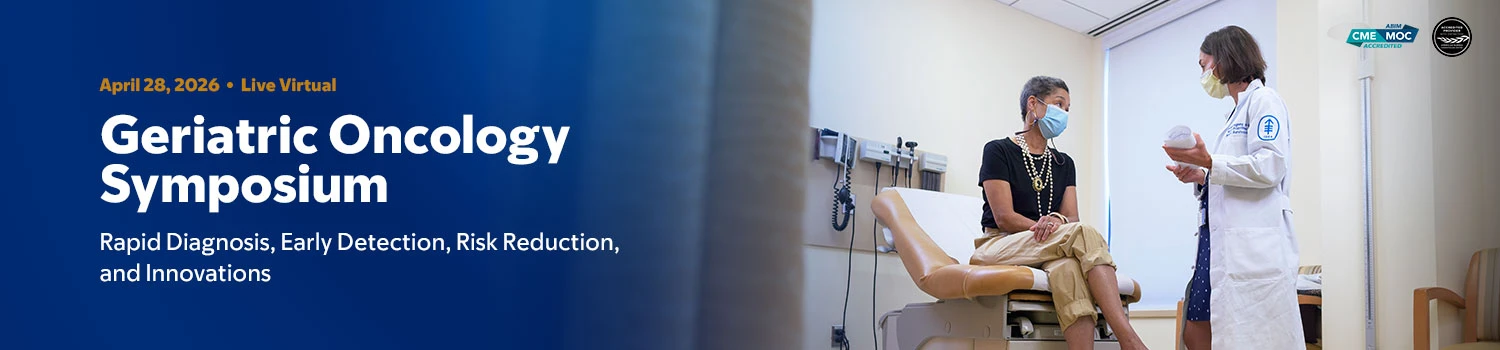
MSKCC Geriatric Oncology Symposium Rapid Diagnosis, Early Detection, Risk Reduction, and Innovations 2026

$30.00
VideoCourse · Geriatric Oncology · 2026
The Geriatric Oncology Symposium 2026 from MSKCC is a one-day, evidence-based virtual program focused on improving how clinicians diagnose, detect, and manage cancer in older adults — with sessions on multimorbidity, digital health, risk stratification, and age-friendly care environments.
-
16lectures
-
1day symposium
-
2026edition
- Explores rapid diagnostic tools and workflows for timely disease detection in geriatric patients
- Addresses cancer screening decisions, postoperative complication prevention, and the ACS Geriatric Surgery Verification program
- Includes Q&A panel discussions on early detection, novel technologies, and optimizing care
One-Day Symposium on Cancer Detection and Care Innovation for Older Adults
The Geriatric Oncology Symposium 2026 is a one-day virtual program from Memorial Sloan Kettering Cancer Center designed to sharpen how clinicians approach cancer in aging patients. Through 16 lectures and panel discussions, faculty examine rapid diagnostic workflows, early detection and risk-reduction strategies, emerging digital health technologies, and the systemic changes needed to deliver age-friendly oncology care.
-
16lectures
-
1day symposium
-
2026edition
Inside this resource
Rapid diagnosis and early detection strategies
The symposium opens with sessions on the CAIT clinic model for risk stratification before chemotherapy and the RADAR framework for identifying cognitive and functional vulnerabilities in older cancer patients. A keynote on caring for patients with multimorbidity sets the stage for understanding how overlapping chronic conditions complicate diagnostic timelines. Panel discussions synthesize the latest evidence on when to initiate screening and how to accelerate accurate detection without over-diagnosing.
Surgical care, risk reduction, and complication prevention
Sessions address how sensory changes affect oncology care decisions, how to minimize postoperative complications in older breast cancer patients, and how the American College of Surgeons Geriatric Surgery Verification program improves perioperative outcomes. Clinicians learn to identify modifiable risk factors before surgery and implement system-level safeguards that reduce harm during and after procedures.
Digital health and technology innovations
Faculty present current research on digital health tools for geriatric oncology, lessons learned from EHR implementation, and upcoming MSK technology innovations. The sessions explore how telehealth, remote monitoring, and electronic health record design can close gaps in care for older adults who face mobility, transportation, and cognitive barriers to in-person visits.
Age-friendly environments and palliative integration
A session on reducing risk in age-friendly environments examines how physical spaces, staffing models, and institutional protocols can be redesigned around the needs of older patients. Palliative care and geriatrics service integration addresses who does what for patients with serious illnesses, ensuring that symptom management and goals-of-care conversations happen alongside — not after — oncologic treatment.
Who this serves
- Oncologists and hematologists — practical strategies for integrating geriatric assessment into cancer treatment planning
- Advanced practice providers and nurses — tools for recognizing geriatric syndromes and coordinating multidisciplinary care
- Surgeons and perioperative clinicians — evidence on reducing complications and implementing age-friendly surgical protocols
- Social workers and case managers — frameworks for addressing psychosocial needs and connecting patients to community resources
Faculty & syllabus
Sessions covered 16 lectures
- CAIT Clinic Model: Updates on Risk Stratification Prior to Chemotherapy
- Case Study
- Digital Health: Updates on Current Research
- EHR Implementation: Lessons Learned
- Good Time to Stop: Cancer Screening in High-risk Older Adults
- Implications of Sensory Changes in Oncology Care
- Improving Care for Older Adults Undergoing Surgery: Implementing the ACS (GSV) Program
- Keynote Address: Caring for Patients with Multimorbidity
- Minimizing Postoperative Complications in Older Adults with Breast Cancer
- Palliative Care and Geriatrics Service: Who Does What for Patients with Serious Illnesses
- RADAR and Older Adult with Cancer
- Reducing Risk in an Age-friendly Environment
- Telehealth and the Older Adult
- Upcoming MSK Technology Innovations
- Early Detection and Risk Reduction Q&A and Panel Discussion
- Novel Technologies and Geriatric Oncology Q&A and Panel Discussion
- Optimizing Care Q&A and Panel Discussion
- Rapid Diagnosis Q&A and Panel Discussion
Before you buy
Is this a full-day program?
Yes — the symposium runs from 8:55 AM to 5:05 PM Eastern on Tuesday, April 28, 2026, with all sessions recorded for on-demand access.
Does the program include subtitles?
Yes — video files ship with VTT subtitle files alongside companion PDFs of the presentation slides.
The chart
| Format | Video course (videos + subtitles + PDFs) |
|---|---|
| Duration | One-day symposium |
| Year | 2026 |
| Publisher | Memorial Sloan Kettering Cancer Center |
| Department | Geriatric |
| Delivery | Instant download after checkout · lifetime re-access |
Verified original fileInstant downloadEncrypted checkout
6 reviews for MSKCC Geriatric Oncology Symposium Rapid Diagnosis, Early Detection, Risk Reduction, and Innovations 2026
Add a review
Related products
Pulmonary /Respiratory
The Brigham Board Review and Comprehensive Update in Pulmonary Medicine 2022

Addiction Medicine
Providence Regional Medical Center Everett 27th Annual Fundamentals of Addiction Medicine 2025

Addiction Medicine
Providence Regional Medical Center Everett 28th Annual Fundamentals of Addiction Medicine 2026

Pulmonary /Respiratory
National Jewish Health 48th Annual Pulmonary & Allergy Update 2026

Addiction Medicine
Harvard Principles of Medical Education: Maximizing Your Teaching Skills 2024 -October Edition
Robert Clarke –
Good overview of digital health tools for geriatric oncology. The EHR implementation session had practical takeaways. One day was compact but the 16 lectures covered the key topics.
Jennifer Huang –
The rapid diagnosis and early detection sessions were exactly what our oncology group needed. The CAIT clinic model presentation gave us a framework we are now implementing.
David Chen –
The ACS Geriatric Surgery Verification program session was useful for our surgical oncology team. Good mix of clinical and systems-level content for a one-day symposium.
S. Patel –
The multimorbidity keynote was outstanding — reframed how I think about treatment decisions in patients with three or more active diagnoses. Panel discussions were engaging.
Natalie Brooks –
Finally a symposium that addresses the real challenges of cancer care in older adults. The sensory-changes-in-oncology session was something I had never seen covered elsewhere.
Laura M. –
One day is a lot to pack in. Some sessions felt rushed and I would have preferred a two-day format for deeper dives. The risk reduction content was solid though.