
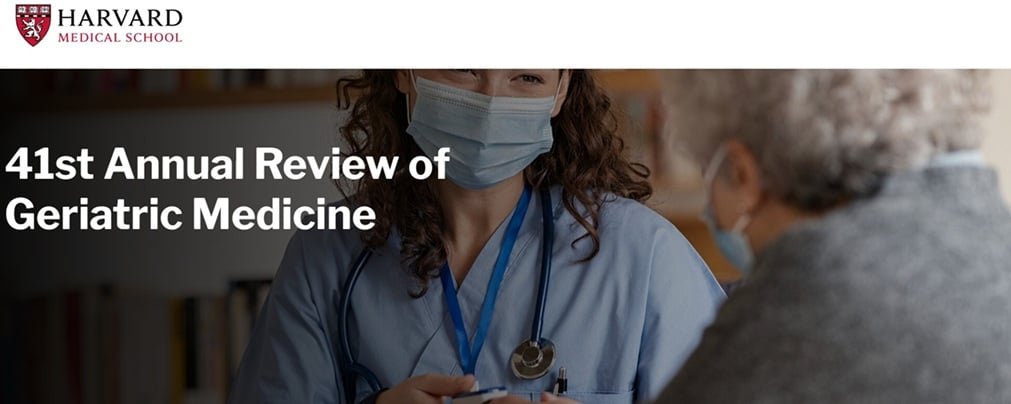
Harvard 41st Annual Review of Geriatric Medicine 2025 (Videos with subtitles + Slides)

$70.00
VideoCourse · Geriatric · 2025
The Harvard Geriatric Medicine 2025 annual review is a five-day multidisciplinary course delivering the latest evidence on managing chronic illness, palliative care, and the geriatric syndromes that shape daily clinical practice for older patients.
-
5day course
-
9learning objectives
-
2025edition
- Covers the altered presentation of common illnesses in older adults and strategies for pain, COPD, infection, and osteoarthritis
- Addresses palliative care, hospice eligibility, and advance care planning for end-of-life decisions
- Aligned with ABMS/ACGME competencies in patient care, medical knowledge, and evidence-based practice
Multidisciplinary Updates in Geriatric Medicine for Clinical Practice
The Harvard Geriatric Medicine 2025 annual review gathers clinicians for five days of lectures and small-group workshops focused on the conditions that dominate primary care for older adults. The program blends medical, neurological, and psychiatric knowledge with practical approaches to complex geriatric problems across office practices, hospitals, and nursing homes.
-
5day course
-
9learning objectives
-
2025edition
Inside this resource
Chronic disease management in older adults
The course develops strategies for managing the medical problems that most frequently present in geriatric patients — COPD exacerbations, persistent pain syndromes, recurrent infections, and progressive osteoarthritis. Participants learn to differentiate normal aging from disease and to tailor treatment plans that respect the physiologic changes of later life.
Palliative care and end-of-life planning
A substantial portion of the curriculum addresses palliative care’s role in supporting older adults at the end of life. You will evaluate when patients qualify for hospice benefits, develop pain-management strategies appropriate to geriatric physiology, and identify opportunities to engage patients in advance care planning conversations before a crisis forces the discussion.
Geriatric syndromes and prescribing
The program reviews the etiologic factors behind the most commonly encountered geriatric syndromes and the principles of appropriate, effective prescribing in older adults. Emphasis is placed on recognizing how common illnesses present differently in seniors and on applying new strategies to optimize medication regimens in patients with multiple comorbidities.
Who this serves
- Primary care physicians — broad updates on the chronic conditions you manage daily in aging patients
- Nurses and nurse practitioners — practical bedside strategies for symptom management and care coordination
- Pharmacists — evidence-based guidance on safe prescribing and deprescribing in older adults
- Specialty physicians, PAs, and psychologists — interdisciplinary knowledge for team-based geriatric care
Before you buy
What is included in the course materials?
The course includes subtitled video recordings of all lectures plus presentation slides for each session, delivered as an instant download.
Which clinical competencies does the course address?
The curriculum is designed to meet ABMS/ACGME competencies in patient care and procedural skills, practice-based learning and improvement, and medical knowledge, as well as IOM competencies in patient-centered care and evidence-based practice.
The chart
| Format | Video course (videos + subtitles + slides) |
|---|---|
| Duration | 5-day course |
| Year | 2025 |
| Publisher | Harvard Medical School |
| Department | Geriatric |
| Delivery | Instant download after checkout · lifetime re-access |
Verified original fileInstant downloadEncrypted checkout
8 reviews for Harvard 41st Annual Review of Geriatric Medicine 2025 (Videos with subtitles + Slides)
Add a review
Related products

Addiction Medicine
The PassMachine Addiction Medicine Board Review 2022 (v3.1) (Beattheboards) (Lectures)

Addiction Medicine
Providence Regional Medical Center Everett 28th Annual Fundamentals of Addiction Medicine 2026


Pulmonary /Respiratory
Addiction Medicine
Harvard Principles of Medical Education: Maximizing Your Teaching Skills 2024 -October Edition
S. Gupta –
Content quality is high but five full days of lectures is a lot to digest. Would prefer the option to purchase individual topic blocks. The pain management section was excellent though.
Thomas Nguyen –
The palliative care section was the strongest part of the course. Clear guidance on hospice eligibility criteria that I now reference regularly in practice.
B. Schwartz –
Packed with clinically useful content. The osteoarthritis and COPD management sessions gave me new approaches for patients who are not candidates for standard therapies.
Rachel M. –
Subtitled videos were a huge plus for me as a non-native English speaker. The slides are clean and the five-day structure keeps topics organized by discipline.
Paula Kim –
Good breadth across geriatric syndromes. The prescribing principles lecture was particularly relevant for my nursing home patients on complex regimens.
Jennifer Park –
Appreciated the ABMS competency alignment — made it easy to document relevance for my professional development file. Strong course overall.
Emily Torres –
Excellent update on differentiating aging from disease. The altered-presentation-of-illness session changed how I approach vague symptoms in my older patients.
A. Mohamed –
The geriatric syndromes and etiologic-factors sessions were exactly what I needed for board prep. Well-organized and the faculty clearly practice what they teach.