
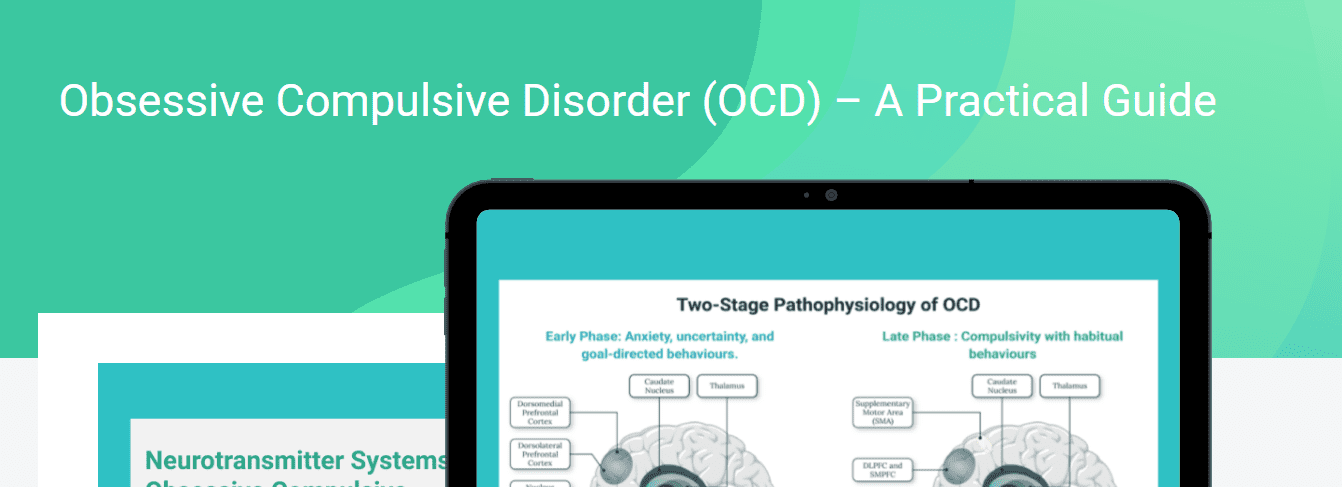
Psychscene Obsessive Compulsive Disorder (OCD) – A Practical Guide


$35.00
eBook / Online Course · OCD · Psychscene
The OCD practical guide by Psychscene delivers 7 modules and 28 units covering diagnosis, neurobiology, pathophysiology, brain activity, management, and comorbidities for mental health professionals.
-
7modules
-
28units
- Covers DSM-5 diagnostic criteria for OCD
- Explores CSTC circuit imbalance and neurotransmitter systems
- Addresses ERP and pharmacotherapy treatment strategies
- Includes module on managing OCD comorbidities
A Comprehensive Course on OCD Diagnosis, Neuroscience, and Clinical Management
The OCD practical guide from Psychscene is a structured learning resource spanning 7 modules and 28 units, designed for doctors, psychiatrists, psychologists, and other mental health professionals. It takes you from diagnostic criteria through the neurobiology and pathophysiology of OCD, into brain activity patterns, and finishes with practical management approaches including ERP and pharmacotherapy for both primary OCD and its comorbidities.
-
7modules
-
28units
Inside this resource
Diagnosing OCD: DSM-5 Criteria and Clinical Identification
Module 1 teaches the DSM-5 diagnostic criteria for OCD, helping clinicians accurately identify obsessions and compulsions and differentiate OCD from related conditions. The OCD practical guide addresses how this frequently missed and misdiagnosed condition presents across clinical populations.
Neurobiology and Pathophysiology
Modules 2 and 3 explore the brain mechanisms underlying OCD, including the imbalance between goal-directed and habit systems mediated by cortico-striato-thalamo-cortical (CSTC) circuit activity. You learn how neurobiological models inform treatment selection.
Brain Activity and Neurotransmitter Systems
Module 4 examines specific brain activity patterns and neurotransmitter systems implicated in OCD pathology. These sessions connect imaging findings with clinical presentation to deepen understanding of why certain treatments work.
Managing OCD and Comorbidities
Modules 5 and 6 cover evidence-based management strategies for OCD symptomatology including exposure and response prevention (ERP) and pharmacotherapy approaches. A dedicated module addresses managing the comorbid conditions that frequently accompany OCD in clinical practice.
Roster
- Psychscene Faculty — psychiatrists and psychologists specializing in OCD clinical education
Frequently asked questions
Is this course suitable for non-psychiatrist clinicians?
Yes, the OCD practical guide is designed for all mental health professionals including doctors, psychiatrists, psychologists, and other healthcare professionals working with patients who have OCD.
Does the course cover ERP and pharmacotherapy together?
Yes, the management modules address both exposure and response prevention (ERP) and pharmacotherapy, plus how to approach treatment when OCD occurs alongside other conditions.
How is the content structured across the 28 units?
The course is divided into 7 modules that progress from diagnosis through neurobiology and pathophysiology to practical management, with a final knowledge check module for self-assessment.
At a glance
| Feature | Detail |
|---|---|
| Format | eBook / online course |
| Modules | 7 |
| Units | 28 |
| Diagnosis | DSM-5 criteria |
| Treatments | ERP, pharmacotherapy |
| Provider | Psychscene |
6 reviews for Psychscene Obsessive Compulsive Disorder (OCD) – A Practical Guide
Add a review
Related products


Psychiatry



Elena V. –
This OCD practical guide from Psychscene helped me understand why OCD is so frequently misdiagnosed. The neurotransmitter systems module connected the science to what I see in clinic every day.
Laura H. –
The 28 units are well-paced and build logically from diagnosis through pathophysiology to treatment. Each module builds on the previous one without redundancy. Excellent for early-career clinicians.
Anna S. –
Finally a course that bridges the neurobiology of OCD with practical management. The CSTC circuit explanation was the clearest I’ve encountered. The OCD practical guide earned a permanent spot in my reference library.
Robert K. –
Solid content on neurobiology but the pharmacotherapy section could use more depth on specific medication protocols. The ERP module was well done though.
Kwame B. –
Strong coverage of DSM-5 criteria and ERP techniques. The comorbidity module was particularly useful for patients who present with overlapping anxiety and depression. Would like more case examples.
James L. –
Comprehensive and well-organized resource. The knowledge check module at the end was a useful self-assessment tool. I recommend this to any clinician working with OCD patients regularly.