
DentistryOnline courseProsthodontics
Mauro Fradeani’s protocol for esthetic rehabilitation on teeth and implants — from facial analysis to MIPP and full-mouth cases
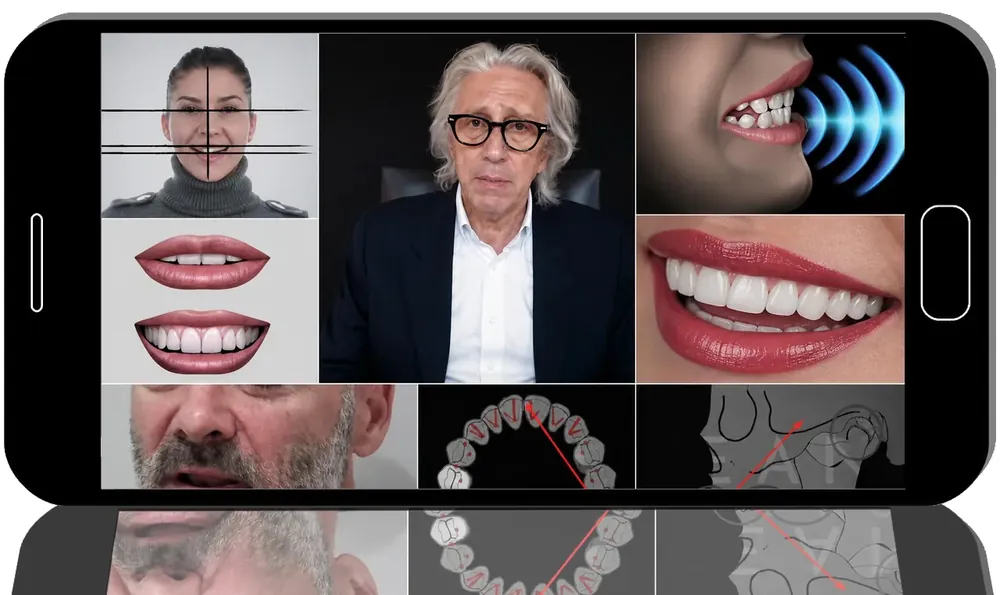
Across ten lessons and 8 h 10 min, Esthetic Rehabilitation sets out the step-by-step method Mauro Fradeani has refined at his Italian practice for more than three decades. You follow planning with facebow, wax-up and mock-up, facial and dentolabial analysis, occlusal assessment, erosive and frictional wear, preparation design, full-arch reconstruction and the choice between zirconia and lithium disilicate.
- 10lessons
- 8 h 10 minof video
- 30+ yearsof the protocol in practice
What you’ll be able to do
- Sequence a prosthetic treatment plan using digital or analogue tools, facebow transfer and mock-ups
- Read the face and smile — incisal edge, smile line, buccal corridor — before touching a tooth
- Decide on centric relation, anterior guidance and vertical dimension changes with a clear rationale
- Diagnose and treat erosion and bruxism-related wear in complex rehabilitations
- Prepare for veneers and crowns with enamel-sparing designs that respect the gingiva
- Match zirconia or lithium disilicate to the indication and restoration type
Inside the course
Diagnosis from the outside in
Early lessons establish natural head posture, frontal and profile facial reference lines, and the dentolabial parameters that decide where the teeth belong. Tooth proportions and gingival contours are then refined separately for natural teeth and implant restorations.
Function and tooth wear
Fradeani explains how the occlusion affects long-term stability, when and how to raise vertical dimension, and how to separate chemical erosion — reflux, bulimia, dietary acids, saliva — from friction linked to bruxism and sleep apnoea.
Preparation and full-arch execution
Conventional versus modern reduction, margin placement at or below the gingiva, veneer preparation and margin-capturing impressions with orthodontic wire lead into a complete rehabilitation: wax-up, mock-up, lab communication, custom anterior guidance, cross-mounting, try-in and cementation.
About Mauro Fradeani
A past president of both the European Academy of Esthetic Dentistry and the Italian Academy of Prosthetic Dentistry, he was visiting associate professor at LSU New Orleans for nearly a decade and founded the Ace Institute and Fradeani Education.
Built for
- Restorative dentistsA structured route from single veneers up to whole-arch cases.
- ProsthodontistsFradeani’s own reasoning on wear, vertical dimension and material limits.
- Dental technicians working with cliniciansInsight into the wax-up, mock-up and cross-mounting stages.
Curriculum
Lesson 1: Structuring a step-by-step roadmap for prosthetic rehabilitation (50 min) 3 topics
- Exploring digital and traditional approaches to treatment planning
- Practical step-by-step guidance for facebow registration and transfer
- Creating and applying diagnostic wax-ups and mock-ups in clinical workflows
Lesson 2: Facial evaluation for esthetic planning in prosthetic rehabilitation (30 min) 4 topics
- Establishing the patient’s natural, relaxed head posture
- Recognizing balanced vs. unbalanced horizontal and vertical relationships
- Assessment of facial structures from the front
- Assessment of facial structures from the side
Lesson 3: Smile design foundations: dentolabial evaluation for prosthetic treatment (38 min) 4 topics
- Incisal edge position and tooth exposure at rest
- Dentolabial asymmetry
- Smile line
- Labial corridor
Lesson 4: Achieving anterior smile harmony with natural teeth and implant restorations (40 min) 4 topics
- Principles of harmonious tooth proportions
- Balanced and coordinated gum contours
- Enhancing esthetics in cases involving natural dentition
- Refining esthetic outcomes in implant-based restorations
Lesson 5: Evaluating function to guide esthetic and prosthetic treatment planning (45 min) 4 topics
- Understanding how the bite influences function and long-term stability
- Centric relation: practical steps, indications, and underlying rationale
- Maximum intercuspation, adapted occlusion, centric occlusal position, and the principles of anterior guidance
- Vertical dimension: clinical methods, timing, and justification for increasing it
Lesson 6: Managing tooth surface loss from dental erosion (35 min) 4 topics
- Internal sources of wear: damage linked to reflux and eating disorders such as bulimia
- External chemical wear: acids from everyday foods and beverages
- Protective and buffering functions of saliva in erosive processes
- Assessing and treating patients with significant erosive tooth loss in complex full-mouth rehabilitations
Lesson 7: Tooth surface loss: the role of friction (45 min) 4 topics
- Normal versus harmful tooth wear caused by friction
- How occlusal relationships influence bruxism
- Interactions between bruxism and obstructive sleep apnea
- Treating patients with significant frictional wear during complex full-mouth rehabilitation
Lesson 8: Merging biology with smile design (1 h) 4 topics
- Conventional and modern approaches to tooth reduction: indications, execution and rationale
- Finishing margins at the gumline and within the sulcus for provisional crowns and bridgework
- Shaping teeth for veneers with a focus on gingival harmony
- Impression strategies using orthodontic wire to reveal and record cervical margins
Lesson 9: A complete guide to rebuilding the entire dentition with prosthetic treatment (1 h 15 min) 5 topics
- Evaluating smile appearance, bite efficiency, and speech characteristics
- Creating a diagnostic wax design and clinical mock-up
- Tooth preparation, definitive impression techniques, and coordination with the laboratory
- Designing individualized anterior guidance and performing cross-mounting procedures
- Clinical try-in, fine-tuning fit and esthetics, and luting the definitive restorations
Lesson 10: Advanced techniques in full-ceramic tooth restorations (1 h) 4 topics
- When zirconia is the material of choice and where its performance reaches its limits
- Situations suited to lithium disilicate and cases where it should be reconsidered
- Veneers, extended veneers, table-top restorations and buccal-occlusal veneer designs compared
- Principles and protocols of the Minimally Invasive Prosthetic Procedure (MIPP)
Before you buy
Does it cover implant-supported restorations as well as teeth?
Yes. Esthetic refinement of implant restorations has its own section, and the planning principles are applied to both.
Is the MIPP concept explained?
The final lesson sets out the principles and protocol of the Minimally Invasive Prosthetic Procedure alongside material selection.
Do I get CME credit or a certificate?
No. Clinicapedia provides the educational content only — no CME or CE credits, MOC points or certificates of completion are included with this product.
Specifications
| Format | Online video course |
|---|---|
| Instructor | Mauro Fradeani |
| Contents | 10 lessons |
| Duration | 8 h 10 min |
| Access | Lifetime, self-paced |
| Department | Dentistry |
| Delivery | Instant download · lifetime re-download |
Related products

Anesthesiology


Dentistry