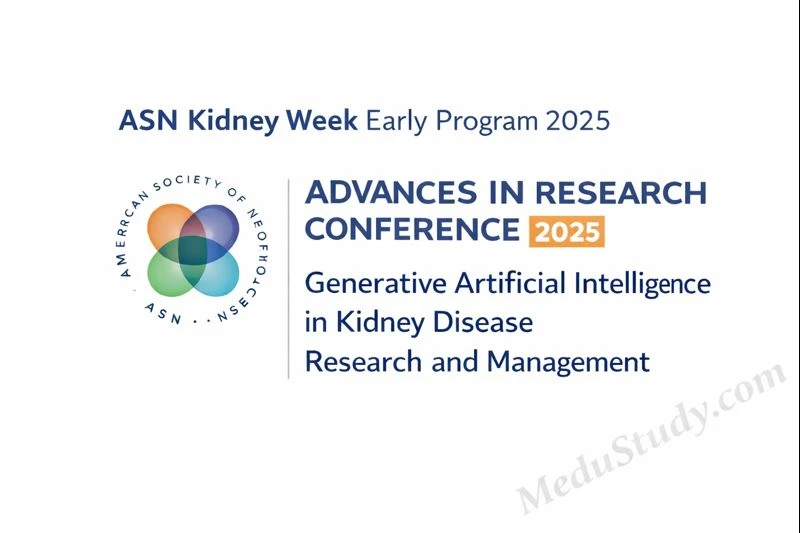
ASN Kidney Week Early Programs 2025 – Advances in Research Conference 2025 Generative Artificial Intelligence in Kidney Disease Research and Management
$120.00
Early Program · Nephrology · 2025
This research conference examines how generative AI kidney disease is accelerating drug discovery, reshaping clinical trial design, and transforming the analysis of large-scale molecular omics data — with practical implications for both basic scientists and clinical researchers.
-
1conference
-
2025year
- Large language models in drug discovery and clinical trial design
- AI-driven prescreening and enrollment eligibility for trials
- Molecular omics data analysis with generative AI
- Translating AI research findings into clinical practice
Generative AI kidney disease — drug discovery, trial design, and translational research
The ASN Advances in Research Conference 2025 brings generative AI kidney disease into sharp focus, exploring how large language models and generative artificial intelligence are transforming basic science, clinical research, and the drug development pipeline. Faculty address practical applications across the research continuum — from molecular omics data analysis and prescreening clinical trial candidates to accelerating drug discovery timelines. The program is designed for researchers who need to understand these tools to evaluate AI-driven molecules and clinical trials critically.
-
1conference
-
2025edition
Inside this resource
Generative AI in drug discovery and trial design
Faculty examine how generative AI applications are compressing drug development timelines — from identifying novel molecular targets to designing clinical trials with adaptive enrichment strategies. Sessions cover event adjudication powered by AI, prescreening and enrollment eligibility optimization, and the practical implications for trial sponsors and investigators. The discussion is grounded in real kidney disease applications, not theoretical possibilities.
Molecular omics and translational research
Dedicated sessions address large-scale molecular omics data analysis using generative AI, demonstrating how these tools identify patterns in genomic and proteomic datasets that traditional methods miss. Faculty discuss strategies for translating clinical research findings into practice through AI-assisted pathophysiology modeling and treatment target identification.
Critical evaluation of AI-driven research
A core objective is equipping researchers to critically evaluate molecules and clinical trials driven by generative AI. The program addresses common pitfalls, validation requirements, and the distinction between AI-assisted hypothesis generation and confirmed clinical evidence — essential knowledge for anyone reviewing AI-influenced submissions or grant applications.
Who this serves
- Clinical researchers — understanding how generative AI changes trial design and drug development
- Basic scientists — applying AI to molecular omics data and pathophysiology research
- Academic nephrologists — critically evaluating AI-driven molecules and clinical trial results
The chart
| Format | Research Conference · Live Course |
|---|---|
| Acknowledgment | NIDDK (75th anniversary), Dr. Eric Brunskill, Dr. Debbie Gipson |
| Publisher | American Society of Nephrology |
| Department | Nephrology |
| Delivery | Instant download after checkout · lifetime re-access |
Verified original fileInstant downloadEncrypted checkout
6 reviews for ASN Kidney Week Early Programs 2025 – Advances in Research Conference 2025 Generative Artificial Intelligence in Kidney Disease Research and Management
Add a review
Related products
Nephrology
Nephrology

Nephrology
Stefan P. –
Essential viewing for anyone in nephrology research. The generative AI applications to trial enrichment and event adjudication alone justified the purchase.
Robert M. –
Content quality is excellent but the single-conference format felt compressed. Would prefer a multi-session series to explore each application area in depth.
Laura C. –
The critical evaluation sessions were the most valuable part. Now I can properly assess AI-driven manuscripts and grant applications. Highly recommend for academic nephrologists.
Yuki T. –
Strong content on molecular omics analysis. Wished for more hands-on examples — the conceptual framework was excellent but implementation details were light.
Daniel F. –
Finally a conference that takes AI in nephrology beyond the hype. The drug discovery applications were concrete and the trial design sessions were directly relevant to my research.
Aisha K. –
Well-organized program with real clinical relevance. The NIDDK acknowledgment was a nice touch. The translational research session connected AI tools to bedside practice effectively.