
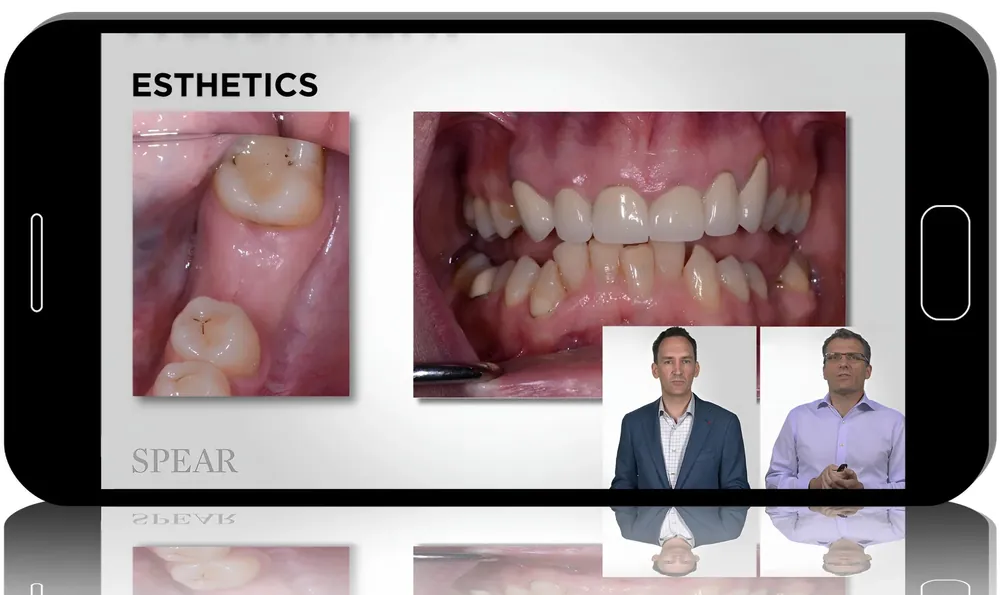


DentistryOnline courseProsthodontics
Plan the crown before the fixture: restorative-led implant planning, guides, biomechanics and a deep dive into abutment choice
Seattle prosthodontist Gregg Kinzer and Spear faculty member Darin Dichter teach Advanced Implant Treatment Planning and Prosthetic Integration across eight modules and 26 lessons (4 h 41 min). Starting from the restorative prototype, they cover implant position and emergence, radiographic and surgical guides, osseointegration and loading, biomechanics, interdisciplinary workflow and — in more than two hours of material — how to pick stock, custom metal, zirconia or hybrid abutments.
- 8modules
- 26lessons
- 4 h 41 minof video
What you’ll be able to do
- Build a restorative prototype that dictates implant position
- Plan for restorative space, soft-tissue contour and emergence
- Communicate position through radiographic and surgical guides and virtual planning
- Factor biomechanics and implant occlusion into the design
- Choose between prefabricated, UCLA and CAD/CAM abutments and decide on retention
Inside the course
Restoration-first thinking
The opening modules assess posterior sites for esthetics, function, structure and biology, then develop a preliminary plan in which the prototype, available space and connection type decide where the implant goes.
From plan to surgery
Guides are explained from the first radiographic template to virtual planning and the finished surgical stent, followed by short modules on implant surfaces, how much integration is needed before loading, and occlusal forces.
The abutment question
Two modules compare prefabricated parts, custom UCLA designs and one- and two-piece CAD/CAM abutments, discuss screw versus cement retention, and match stock, metal, zirconia and hybrid options to indications. A conversation with lab technician Bob Winter adds the technician’s view.
Working as a team
A dedicated lesson outlines how restorative dentist, surgeon and lab coordinate an implant case from start to finish.
Built for
- Restorative dentists who restore implantsBetter control over the result by guiding placement from the start.
- Implant surgeonsInsight into what the restorative side needs from fixture position.
- Prosthodontists and lab partnersA practical framework for abutment selection.
Curriculum
Module 1: Prosthetically Driven Treatment Planning for Implants (29 min) 3 lessons
- Esthetics and Function for Posterior Implants
- Structure
- Biology
Module 2: Implant Treatment Planning — Developing the Preliminary Restorative Plan (35 min) 4 lessons
- The Restorative Prototype
- Restorative Space, Soft Tissue Contour and Implant Position
- Prosthetic Connection and Emergence
- Abutment Selection
Module 3: Understanding Radiographic and Surgical Guides (26 min) 4 lessons
- Communicating Desired Implant Position
- Radiographic Guides and Virtual Implant Planning
- Surgical Guides
- Implementing Radiographic and Surgical Guides
Module 4: Osseointegration and Implant Loading Protocol (14 min) 2 lessons
- Implant Surface Considerations
- How Much is Enough
Module 5: Implant Biomechanics (18 min) 2 lessons
- Biomechanics and Implant Planning
- Biomechanics and Implant Occlusion
Module 6: Abutment Selection (1 h 37 min) 6 lessons
- Prefabricated Abutments
- Custom UCLA Abutments
- Custom One-Piece CAD CAM Abutments
- Custom Two-Piece CAD CAM Abutments
- Retention
- Gregg Kinzer and Bob Winter Talk Abutment Selection
Module 7: Interdisciplinary Workflows for Dental Implants (21 min) 1 lesson
- Interdisciplinary Workflows for Dental Implants
Module 8: Indications for Choosing the Right Abutment (41 min) 4 lessons
- Abutment Selection: Stock
- Abutment Selection: Custom Metal
- Abutment Selection: Custom Zirconia
- Abutment Selection: Custom Hybrid
Before you buy
Is implant surgery demonstrated?
No, the emphasis is planning and prosthetics; surgical placement is discussed through guides rather than shown as a procedure.
Why does abutment selection appear in several modules?
It is the course’s main theme, so it recurs in the planning module, a long dedicated module and a final indications module, with some natural overlap.
Are the loading and biomechanics sections detailed?
They are brief — 14 and 18 minutes — and work best as a concise summary.
Do I get CME credit or a certificate?
No. Clinicapedia provides the educational content only — no CME or CE credits, MOC points or certificates of completion are included with this product.
Specifications
| Format | Online video course |
|---|---|
| Instructors | Gregg Kinzer, Darin Dichter |
| Contents | 8 modules · 26 lessons |
| Duration | 4 h 41 min |
| Access | Lifetime, self-paced |
| Department | Dentistry |
| Delivery | Instant download · lifetime re-download |
Related products

Dentistry

Addiction Medicine


Dentistry
