DentistryOnline courseGnathology
Choosing the mandibular position before you rebuild the bite — CR, CO and neuromuscular registration compared by four clinicians
Before an occlusal rehabilitation or orthodontic finish, you have to decide where the mandible should sit. Reference Position Centric Relation (CR), Centric Occlusion (CO), Neuro-Muscular RP puts four views side by side: Jean-Daniel Orthlieb, Nazzareno Bassetti, Michael Miyasaki and Giorgio De’ Luca teach six lessons, 5 h 48 min in total, on registration rules, reference planes, vertical dimension and splints built to a neuromuscular position, with both analogue and digital workflows.
- 6lessons
- 5 h 48 minof video
- 4instructors
What you’ll be able to do
- Follow a stepwise registration protocol to move from ICP to a therapeutic reference position
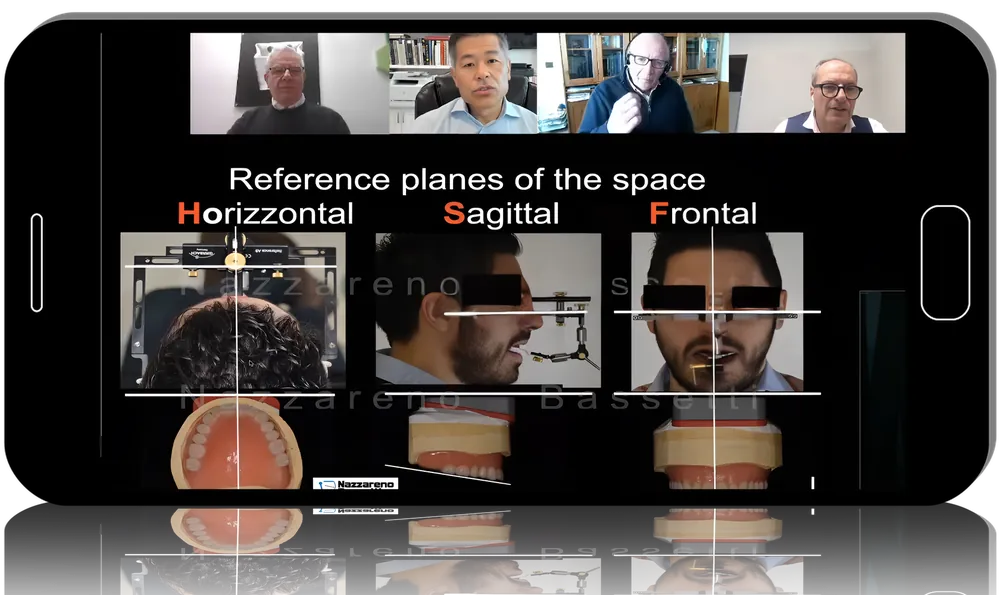
- Set a horizontal reference plane with a facebow, including in facial asymmetry
- Distinguish stable from unstable ICP and relate it to vertical dimension
- Record CR with a neuromuscular approach and plan phase II of treatment
- Design an occlusal splint in the chosen position, by waxing or digitally
Inside the course
Reference position and the occlusal plane
The longest lesson covers physiological versus deranged positions, Sato’s view of occlusal plane and malocclusion, plane control, skeletal classification, digital functional smile design, gnathologically guided implant work and ten therapeutic concepts.
Planes, positions and vertical dimension
Three options for building a horizontal reference plane, the ARP index, and how muscles establish a reproducible mandibular position in ICP and CR.
The neuromuscular route
Habitual bite, physiologic versus accommodative trajectories, diagnostic equipment, an examination algorithm, orthotic types and a worn-dentition example; then a lesson placing the neuromuscular position alongside Slavicek’s definition, with articulator mounting and digital determination.
From position to splint
Video demonstrations of waxing to the reference position, adjusting a splint on the articulator, and a digital splint design workflow, closing with case analysis.
Built for
- Clinicians planning full-mouth rehabilitationA reasoned choice of starting position before changing vertical dimension.
- Orthodontists finishing to a functional targetPlane control and positional diagnosis frame the end point.
- Dental technicians mounting castsFacebow and articulator protocols clarify what the clinic sends.
Curriculum
Lessons (5 h 48 min) 6 lessons
- Reference position. Working with the occlusal plane (1 h 39 min)
- Definition of the reference plane (36 min)
- The concept of mandible reference position and the vertical dimension of occlusion (22 min)
- CR registration using neuromuscular approach. How to achieve stable results (1 h 30 min)
- Neuro-muscular reference position for diagnostic and therapeutic goals (54 min)
- Analog and digital determination of neuro-muscular reference position (44 min)
Before you buy
Do the instructors agree on one “correct” position?
No — the lessons come from different schools, gnathological and neuromuscular, so you get contrasting protocols rather than a single doctrine.
Is special neuromuscular equipment needed?
One lesson reviews the diagnostic devices used in that approach; the facebow, articulator and splint lessons work with standard lab equipment.
Does it overlap with other Slavicek-school titles?
Slavicek’s reference position is discussed as a comparison, so owners of those courses will recognise some concepts.
Do I get CME credit or a certificate?
No. Clinicapedia provides the educational content only — no CME or CE credits, MOC points or certificates of completion are included with this product.
Specifications
| Format | Online video course |
|---|---|
| Instructors | J.-D. Orthlieb, N. Bassetti, M. Miyasaki, G. De’ Luca |
| Contents | 6 lessons |
| Duration | 5 h 48 min |
| Access | Lifetime, self-paced |
| Department | Dentistry |
| Delivery | Instant download · lifetime re-download |
Related products