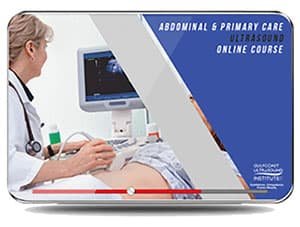
GCUS Abdominal and Primary Care Ultrasound 2022 (Gulfcoast Ultrasound Institute) (Videos) 2022
$55.00
VIDEO COURSE · Gulfcoast Ultrasound Institute · 2022
The abdominal primary care ultrasound course from Gulfcoast delivers thirteen recorded lectures covering core ultrasound applications as outlined in the AIUM practice guidelines. Taught by expert physicians and sonographers, the curriculum spans liver through thyroid, scrotal and soft tissue evaluation, and the EFAST trauma exam.
-
13video lectures
-
7.35 GBlibrary size
-
13topics covered
-
2022edition
- Complete abdominal organ evaluation: liver, gallbladder, pancreas, spleen, kidneys
- Thyroid, scrotal, and soft tissue ultrasound applications
- EFAST exam for trauma patient evaluation
- Abdominal case studies for pattern reinforcement
Abdominal primary care ultrasound for core diagnostic applications
This abdominal primary care ultrasound course from Gulfcoast provides a strong foundation in the core ultrasound applications outlined in the AIUM practice guidelines. Thirteen lectures cover transducer technique, system optimization, and organ-specific evaluation from the liver and gallbladder through the thyroid and scrotum. The program is taught by expert physicians and sonographers who balance clinical experience with scanning expertise.
-
13video lectures
-
7.35 GBlibrary size
-
13topic modules
-
2022edition
Inside this resource
Abdominal organ evaluation: liver through kidneys
The curriculum begins with imaging fundamentals and abdominal sonography anatomy, then progresses through dedicated liver, gallbladder, biliary tree, and spleen evaluation — covering both normal findings and pathology. Renal sonography and pancreatic assessment are presented with scan protocols and measurement techniques for routine clinical use.
Thyroid, scrotal, soft tissue, and trauma applications
Beyond the abdomen, lectures address thyroid evaluation, scrotal ultrasound, and soft tissue pathology. The EFAST exam module provides the protocol-driven approach needed for trauma patient evaluation. A dedicated appendix and GI tract session rounds out the gastrointestinal coverage.
Case studies and scan technique demonstrations
The course concludes with abdominal case studies that apply the organ-specific protocols in real clinical scenarios. Transducer manipulation and system optimization are demonstrated throughout, providing the practical scanning skills needed for immediate clinical application.
Who this serves
- Sonographers — build foundational abdominal scanning competency aligned with AIUM guidelines
- Primary care and emergency physicians — develop bedside ultrasound skills for organ evaluation and trauma assessment
- Internists and hospitalists — add point-of-care abdominal ultrasound to clinical practice
Faculty & syllabus
Topics covered 13 sessions
- Imaging Fundamentals: The Basics
- Abdominal Sonography Anatomy and Scan Fundamentals
- Ultrasound Evaluation of the Abdominal Aorta
- Normal Liver, Gallbladder, Biliary Tree, and Spleen Sonography
- Ultrasound Evaluation of Liver, Gallbladder, and Biliary Tree Pathology
- Renal Sonography and Pathology
- Ultrasound Evaluation of the Pancreas
- The EFAST Exam
- Ultrasound Evaluation of the Appendix and GI Tract
- Ultrasound Evaluation of the Thyroid
- Scrotal Ultrasound
- Ultrasound Evaluation of Soft Tissues
- Abdominal Case Studies
Before you buy
Does this include the EFAST exam?
Yes — module eight covers the EFAST exam for trauma patient evaluation alongside the standard abdominal organ assessment lectures.
What is the total content size?
13 MP4 video files totaling 7.35 GB, downloadable after purchase with lifetime re-access.
The chart
| Format | 13 video lectures (MP4) |
|---|---|
| File Size | 7.35 GB |
| Year | 2022 |
| Publisher | Gulfcoast Ultrasound Institute |
| Department | Gulfcoast Ultrasound Institute |
| Delivery | Instant download after checkout · lifetime re-access |
Verified original fileInstant downloadEncrypted checkout
6 reviews for GCUS Abdominal and Primary Care Ultrasound 2022 (Gulfcoast Ultrasound Institute) (Videos) 2022
Add a review
Related products
Gulfcoast Ultrasound Institute
Gulfcoast Ultrasound Institute
AIUM VIDEO HD Musculoskeletal Ultrasound of Sports Injuries and Hernias
Gulfcoast Ultrasound Institute
Gulfcoast Use of Ultrasound in Rheumatology Applications (Videos+PDFs)
Gulfcoast Ultrasound Institute
Gulfcoast Ultrasound Institute
Gulfcoast Upper Extremity Musculoskeletal Ultrasound Protocols (Videos)
Gulfcoast Ultrasound Institute
Gulfcoast Ultrasound Institute
GCUS Introduction to Transcranial Doppler Ultrasound 2019 (VIDEOS)
Gulfcoast Ultrasound Institute
Gulfcoast Dynamic Musculoskeletal Ultrasound Imaging (Videos+PDFs)
Jason Y. –
Well-paced course that progresses logically from fundamentals through each organ system. The case studies at the end bring everything together.
Peter B. –
Solid organ-by-organ review. The renal sonography and pathology module is thorough. The appendix and GI tract session is a useful addition.
Maria L. –
Thirteen lectures cover the full AIUM core curriculum. The thyroid and scrotal ultrasound modules add breadth beyond the standard abdominal content.
Andrea G. –
Downloaded for a primary care rotation. The transducer technique demonstrations throughout the course made the scanning skills immediately applicable in clinic.
Steve W. –
Comprehensive abdominal course at 7.35 GB. The liver and biliary tree pathology sessions are excellent. The EFAST module is a practical bonus for emergency clinicians.
Cathy N. –
Good content overall but the 7.35 GB file size requires significant storage. The pancreatic evaluation module could use more pathology examples.