
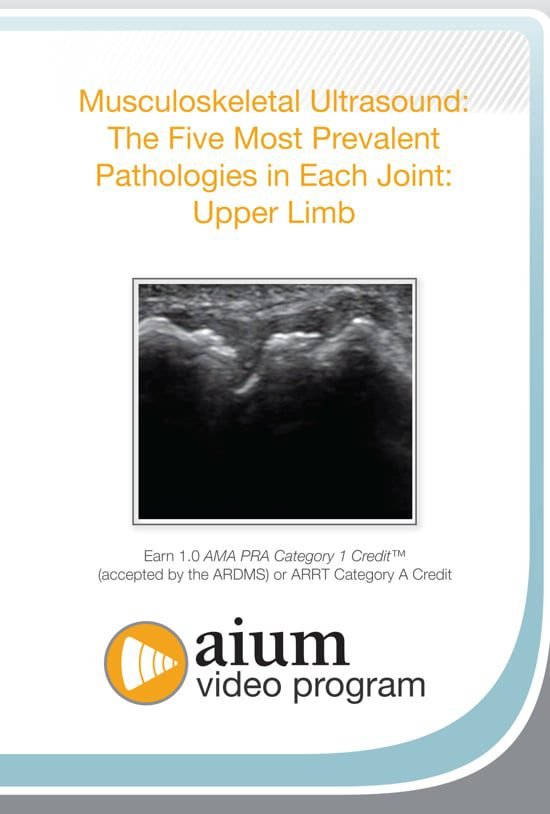
MSK Ultrasound: The Five Most Prevalent Pathologies in Each Joint: Upper Limb

$15.00
VIDEO COURSE · AIUM · MSK Upper Limb
This upper limb MSK pathologies course covers the five most prevalent pathologies in the shoulder, hand, and wrist from both clinical and ultrasound perspectives — addressing the relevant anatomy, imaging technique, and basic pathology with dynamic ultrasound techniques for each upper limb joint.
-
3joint regions
- Five most common pathologies in shoulder, hand, and wrist
- Dynamic ultrasound techniques for upper limb assessment
- Clinical and sonographic perspective integration
- Relevant anatomy and imaging technique per joint
Upper limb MSK ultrasound: five pathologies per joint in shoulder, hand, and wrist
This upper limb MSK pathologies course from the AIUM covers the five most prevalent ultrasound findings in the shoulder, hand, and wrist — presented from both clinical and sonographic perspectives. Each joint receives dedicated attention with the relevant anatomy, imaging technique, and dynamic ultrasound applications that reveal pathology static scans miss.
Inside this resource
Shoulder ultrasonography: top five pathologies
The shoulder module addresses the five most prevalent pathologies — rotator cuff tears, tendinopathy, bursitis, labral pathology, and biceps tendon disorders. Each condition is presented with its sonographic appearance and the dynamic manoeuvres that confirm or exclude the diagnosis, connecting the clinical presentation to the imaging findings.
Hand and wrist ultrasound assessment
The hand and wrist section covers the top five most prevalent pathologies — including tendinopathy, ligament injuries, carpal tunnel syndrome, and ganglion cysts. The module addresses the relevant anatomy, imaging technique, and how dynamic ultrasound assessment reveals pathology that conventional static imaging may miss.
Integrated anatomy and technique
Each joint module begins with the relevant anatomy before advancing to pathology assessment — establishing the normal baseline that allows pattern recognition of abnormal findings. The technique focus ensures clinicians understand not just what to look for but how to position the patient and transducer for optimal visualisation.
Who this serves
- Sonographers in upper limb MSK practice — build systematic knowledge of shoulder, hand, and wrist pathology
- Orthopaedic surgeons — understand sonographic patterns in common upper extremity conditions
- Sports medicine physicians — develop dynamic ultrasound skills for upper limb injury assessment
Before you buy
Is this an upper-limb-only course?
This volume covers the upper limb (shoulder, hand, wrist). A companion volume covers the lower limb (knee, hip, ankle).
Does this cover dynamic assessment?
Yes — dynamic ultrasound techniques are used throughout to demonstrate how joint movement and stress manoeuvres reveal pathology that static scanning may miss.
The chart
| Format | Video lectures (MP4) |
|---|---|
| Publisher | AIUM |
| Department | Gulfcoast Ultrasound Institute |
| Delivery | Instant download after checkout · lifetime re-access |
Verified original fileInstant downloadEncrypted checkout
5 reviews for MSK Ultrasound: The Five Most Prevalent Pathologies in Each Joint: Upper Limb
Add a review
Related products

Gulfcoast Ultrasound Institute

Gulfcoast Ultrasound Institute
GCUS Introduction to Carotid Duplex/Color Flow Ultrasound 2022 (VIDEOS)
Gulfcoast Ultrasound Institute
Gulfcoast Ultrasound Institute
Gulfcoast Dynamic Musculoskeletal Ultrasound Imaging (Videos+PDFs)

Gulfcoast Ultrasound Institute
Gulfcoast Ultrasound Institute
Gulfcoast Ultrasound Institute
Gulfcoast Upper Extremity Musculoskeletal Ultrasound Protocols (Videos)

Gulfcoast Ultrasound Institute
Marcus J. –
Downloaded alongside the lower limb volume. Together they provide a comprehensive MSK ultrasound reference for all major joints.
M. Alvarez –
The shoulder module is excellent. Rotator cuff pathology and dynamic assessment techniques are clearly demonstrated with clinical correlation throughout.
Priya –
Well-structured joint-by-joint approach. The hand and wrist section covers conditions I encounter regularly — practical for everyday MSK scanning practice.
Lynn C. –
Content is solid but I wanted more case examples in the hand and wrist module. The shoulder section is the strongest part of the course.
Sarah K. –
Good coverage of shoulder, hand, and wrist pathologies. The dynamic ultrasound approach adds value over static scanning for upper limb assessment.